Everyone You Know, and Everyone You Don’t
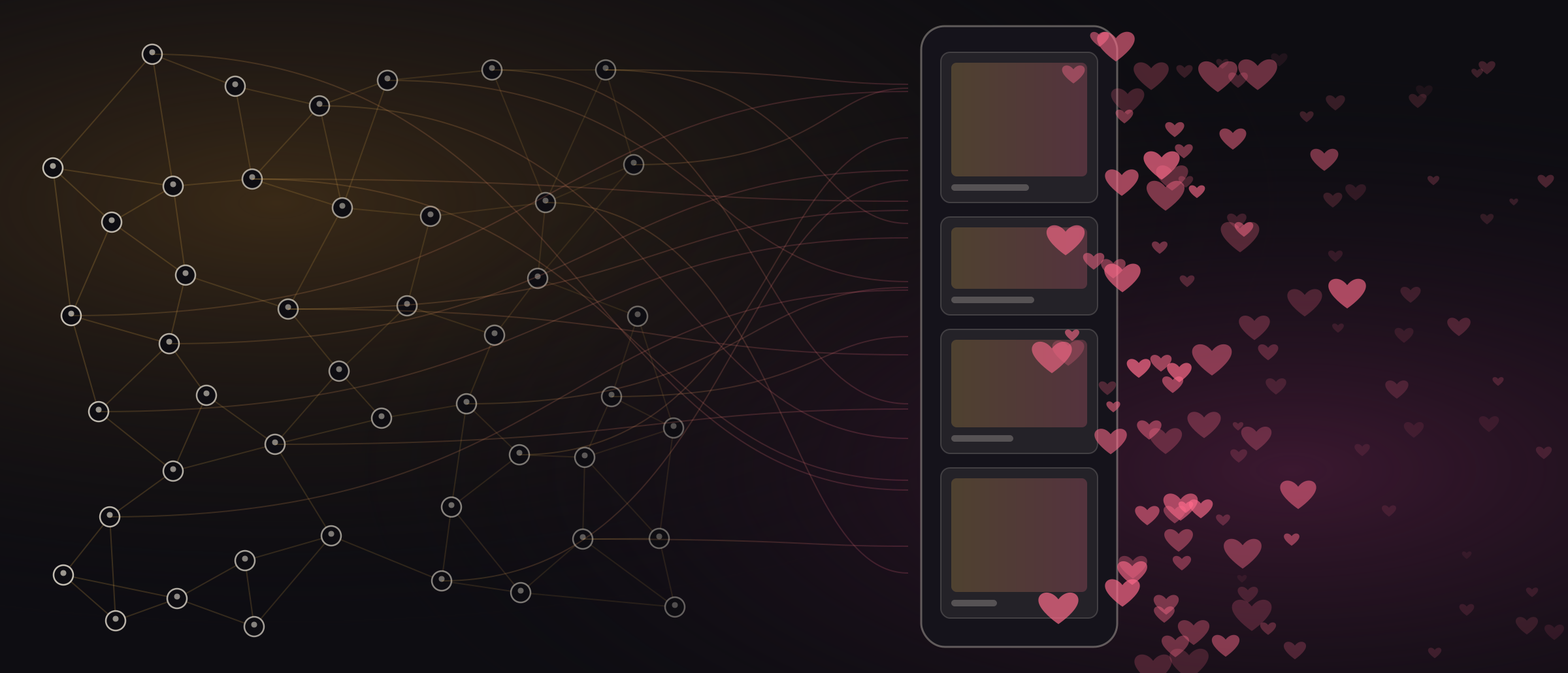
Why did software built to help people keep up with their friends turn, within twenty years, into a machine for showing strangers to strangers?
Social media began as a way to see your friends and became a way to be seen by strangers. Across thirty years, from SixDegrees and Friendster to Facebook, Instagram and TikTok, each platform made a different bet about what people want from each other, and each bet reshaped friendship, fame, news and advertising. This is the history of those bets, the platforms that grew and vanished, the strategy that made Meta, and the psychology and philosophy underneath them.
For people who build products
Decisions worth studying
9 decisions from this history, each with the situation, the alternatives, what happened and a verdict. Open one for the full case. The verdict says how a decision turned out, which is not the same as whether it was wise; see moral luck.
-
Require real names and college email addresses, and open one campus at a time Launch where you can reach density quickly, and grow only as fast as the product can stay reliable.
- Situation
- Friendster had buckled under growth and MySpace was cluttered with fake profiles and spam.
- Alternatives
- Open sign-up to anyone at once, as Friendster and MySpace had done.
- Numbers
- About half of Harvard’s undergraduates joined within a month; open to everyone from September 2006; 1 billion monthly users by October 2012.
- What happened
- Each launch reached a dense community where friends were already present. The site rarely went down or felt empty, and the real-identity graph later became the basis of its advertising.
- Verdict
- Constrained growth was the decisive advantage over Friendster: Facebook chose density and reliability over raw sign-ups.
A small working thing beats a grand designNetwork effects run in both directions
-
Turn profiles into News Feed, a continuous stream of friends’ activity When a feature exposes users more, ship the controls with it, not after the protest.
- Situation
- Users had to visit profiles one by one to see what had changed.
- Alternatives
- Keep profiles as the main surface, with optional notifications.
- Numbers
- Hundreds of thousands joined protest groups within about a day of launch.
- What happened
- Hundreds of thousands of users protested within days, privacy controls were added afterwards, and usage grew. Every later social feed descends from it.
- Verdict
- The direction was right; the execution was not. Shipping a change in exposure without the controls to manage it produced a revolt that better preparation could have avoided.
-
Decline Google’s offer and keep growing while the site slowed and fake profiles were deleted Never let the experience decay during your fastest growth; and do not go to war with your earliest users’ culture.
- Situation
- Friendster was growing explosively and its founder and investors hoped to build something larger.
- Alternatives
- Sell, or pause growth to rebuild the infrastructure; tolerate “Fakester” profiles that early users enjoyed.
- Numbers
- Google’s 2003 offer was reported at about $30 million.
- What happened
- Users drifted to MySpace while the company was distracted by board disputes and changes of chief executive.
- Verdict
- In a network product reliability is the product. Friendster let performance decay at the moment of peak attention and fought its own most enthusiastic users.
-
Buy Instagram and WhatsApp while they were young Buy the format your users are moving toward before it is obvious, and expect regulators to ask why later.
- Situation
- Younger users were moving to mobile-first apps, and Facebook’s own app was weak on phones.
- Alternatives
- Compete with its own products, or wait and see which apps lasted.
- Numbers
- Instagram: $1 billion, about 13 employees, 18 months old. WhatsApp: $19 billion, about 450 million users. Instagram passed 3 billion monthly users in 2025.
- What happened
- Both became billion-user products inside Meta. The FTC sued in 2020, and a US court ruled in 2025 that Meta did not hold monopoly power in today’s market.
- Verdict
- Commercially among the best acquisitions in technology. Whether they were good for competition remains contested; internal emails show leaders explicitly weighing the neutralisation of a potential competitor.
-
Copy Snapchat’s Stories format openly Novelty is not a moat. If your advantage is a format, assume a larger competitor will ship it within a year.
- Situation
- Snapchat had declined a reported $3 billion offer from Facebook in 2013, and Stories had become the defining format for young users.
- Alternatives
- Build a different format, or keep trying to buy Snapchat.
- What happened
- Instagram Stories soon had more daily users than all of Snapchat.
- Verdict
- A format is easy to copy; an audience of hundreds of millions is not. Systrom credited Snapchat publicly, which acknowledged the source without changing the result.
Incumbents absorb the challenger’s best ideaDistribution beats elegance
-
Choose every video with a recommendation model instead of from the people you follow Ask whether the moat everyone believes in is really what users value, or only what incumbents have.
- Situation
- ByteDance had built Toutiao around machine-chosen news. Rivals depended on their users’ social graphs.
- Alternatives
- Build another friend-based network; or keep Musical.ly as a separate app instead of merging it.
- Numbers
- Musical.ly bought for a reported $800 million to $1 billion in 2017; TikTok passed 1 billion monthly users in September 2021.
- What happened
- A new user needed no friends to get an engaging feed. Every major platform copied the approach.
- Verdict
- It bypassed the asset everyone assumed was the moat, the social graph, and made it far less important.
-
Run a creator-driven video app without giving creators a way to earn In a creator product, pay the people who make the content or expect them to leave.
- Situation
- Vine’s six-second loops produced a generation of comic stars.
- Alternatives
- Share advertising revenue or build creator funds, as YouTube did.
- Numbers
- Bought for a reported $30 million in 2012; by July 2016 more than half of its top 9,725 accounts had stopped posting.
- What happened
- Creators moved to YouTube, Instagram and later TikTok. Twitter announced the end of Vine’s app in October 2016.
- Verdict
- The supply side of the product was its creators, and the company gave them no reason to stay once larger platforms offered money and reach.
Who pays shapes what gets builtNetwork effects run in both directions
-
Build a social network on top of everyone’s Google account Do not confuse distribution with demand: count what people do, not how many accounts exist.
- Situation
- Google had distribution through Gmail, Android and YouTube, but no social network of its own.
- Alternatives
- Acquire a network, or build smaller social features inside existing products.
- Numbers
- 90% of Google+ user sessions lasted less than five seconds; up to 500,000 profiles were exposed by an API flaw.
- What happened
- Many people had profiles they never chose to use. The consumer service closed in 2019 after a data exposure was disclosed.
- Verdict
- Accounts were mistaken for engagement. Distribution created profiles, not relationships.
Network effects run in both directionsThe metric becomes the target
-
Re-rank the feed for “meaningful social interactions” Before you optimise a proxy, ask what the worst content that scores well on it would be.
- Situation
- Public posts from brands and media were crowding out posts from friends.
- Alternatives
- Keep ranking for relevance and time spent.
- What happened
- Friends’ posts and posts that drew comments rose in the feed. Later reporting suggested that rewarding comments also rewarded divisive posts.
- Verdict
- The intention was right, but the proxy chosen for “meaningful”, conversation and comments, could be satisfied by arguments as easily as by connection.
In the middle of 2026, two in three people on Earth were using social media. DataReportal counted about 5.8 billion social media “user identities” in April that year, while noting that one person can hold several.1 Meta alone reported that 3.6 billion people used at least one of its apps every day.2 No technology in history has reached so many people so quickly, and few have changed so many ordinary activities at once: how friends keep in touch, how news travels, how products are sold, how politics is argued, and how young people come to see themselves.
The products that did this have changed so often that their history can be hard to see. Some of the most famous names, such as Friendster, MySpace, Orkut, Vine and Google+, rose to tens or hundreds of millions of users and then disappeared. One company, Facebook, now Meta, has stayed at the centre for twenty years, partly by building and partly by buying. And the meaning of the word “social” has quietly reversed. The early networks were built around the people you already knew. The most successful feed of the 2020s, TikTok’s, does not need to know who your friends are at all.
That reversal is the puzzle worth investigating. Why did software designed to help people keep up with their friends turn, within twenty years, into a system for showing strangers to strangers? The answer runs through a long series of decisions, each one a bet about what people want from each other: to be found, to perform, to be recognised, to compare, to belong, to be entertained. Each bet changed people as well as products. To understand where social media is now, we have to follow the bets one by one, and look at the psychology that made each of them work.
Before social media: communities without a feed
People formed communities online long before anyone called it social media. In the late 1970s and 1980s, bulletin board systems (BBSs) let people dial into a computer to post messages and swap files. Usenet, from 1980, organised discussions into thousands of newsgroups that anyone on the network could read. The WELL, founded in the San Francisco Bay Area in 1985, became famous for the closeness of its members; the writer Howard Rheingold drew on it for his 1993 book The Virtual Community. In the 1990s came chat rooms, AOL’s member profiles, instant messaging and “homesteading” sites such as GeoCities, where anyone could build a home page.
These early communities were organised around topics and places. You joined a newsgroup about astronomy or a board for your city, and you met whoever else was there. Identity was usually a nickname. What did not exist was a structure organised around people, in which your connections themselves were the content.
The psychology of the period matters. Online life was seen as separate from real life: a place you went to, through a slow dial-up connection, and left. Many users valued exactly that separation, the chance to try out a different identity. The idea of putting your real name, real face and real friends online would have struck many of them as strange.
The friend list becomes a product: SixDegrees and Friendster
The communications scholars danah boyd and Nicole Ellison, in a widely cited 2007 history, defined social network sites by three features: a public or semi-public profile, a list of other users with whom one shares a connection, and the ability to view and traverse those lists.3 By that definition, the first was SixDegrees.com, launched in 1997 by Andrew Weinreich and named after the idea that any two people are linked by a short chain of acquaintances. Users listed their friends, invited them to join, and could browse friends of friends.
SixDegrees attracted millions of registrations but closed around 2000. Its founder later suggested it was ahead of its time, and boyd and Ellison note that many early users had few friends online to connect with and little to do once they had.3 A network made of people is valuable only when the people are there. In the late 1990s, most of them were not.
Friendster, launched in 2002 by Jonathan Abrams, arrived when they were. It began as a dating site with a twist: instead of meeting strangers, users would meet friends of friends, whose connection made them seem safer and more interesting. Friendster grew explosively through 2003, largely by word of mouth among young adults in American cities. In 2003, according to a later New York Times account, Google offered about $30 million to buy it, and Abrams and his investors declined, hoping to build something larger.4
Friendster’s decline became a case study in how a social network can fail. The site struggled technically as it grew: computing every user’s network of friends of friends was expensive, and pages became slow to load. The company also took a strict view of identity, deleting “Fakester” profiles that users had created for celebrities, fictional characters and jokes, which many early users had treated as part of the fun.3 The Times account describes a company distracted by board disputes and changes of chief executive while its users waited.4 Its American users drifted to MySpace; the site remained popular for some years in Southeast Asia, and later closed as a social network.
Friendster showed two things that every later platform had to learn. First, a social network’s growth can accelerate itself, because each new user makes it more valuable for their friends. Second, the same effect runs in reverse. When people start to leave, the site becomes less valuable for everyone who stays, and decline can be as fast as growth.
MySpace: the profile as a stage
MySpace launched in 2003, built by employees of an internet marketing company in Los Angeles, and took a different view of what users wanted. Where Friendster tightly controlled profiles, MySpace let users change their pages with their own HTML and CSS: backgrounds, music players, glittering graphics, embedded videos. Every new user’s first friend was “Tom,” the co-founder Tom Anderson, a small touch that made a large site feel personal. Users could rank their “Top 8” friends on their profiles, making the hierarchy of friendship visible.
MySpace became the home of music online. Bands, from garage groups to stars, set up profiles to share songs and reach fans directly, and the site helped several artists break through. Its users were young, and the profile became a way of performing who you were, through taste, design and the friends you displayed.
In July 2005, News Corporation bought MySpace’s parent company for $580 million.5 In 2006 MySpace was among the most visited websites in the United States. But its openness had costs. Customised pages were often slow and chaotic; spam and fake profiles multiplied; and under its new owner the site added more advertising. danah boyd, who studied American teenagers at the time, observed in 2007 that teenagers’ choice between MySpace and Facebook was beginning to follow lines of class and education, with Facebook associated with students heading to college and MySpace with others.6 As Facebook opened to everyone, much of MySpace’s audience moved. In 2011 News Corp sold MySpace for about $35 million.5
A final episode shows how fragile the record of this era is. In 2019 MySpace acknowledged that music uploaded between 2003 and 2015, an estimated 50 million songs from 14 million artists, had been lost during a server migration.7 A cultural archive that millions of people had built for free existed only as long as a company chose to keep it.
A year of beginnings: 2003–2005
MySpace was one of many experiments in the same few years, each built around a different idea of what people would share.
LinkedIn (2003): the network as a résumé
LinkedIn launched in May 2003 as a network for professionals. Its bet was that the most valuable connections for many people were work contacts, and that a profile could serve as a permanent, public résumé. It grew more slowly than the youth networks but steadily, because its value did not depend on fashion. Microsoft bought it in 2016 for $26.2 billion.8 LinkedIn remains the clearest example of a network built around what the sociologist Mark Granovetter called weak ties, discussed later in this essay.
Flickr (2004): community around photographs
Flickr began inside Ludicorp, a small Vancouver company founded by Stewart Butterfield and Caterina Fake that was building an online game called Game Neverending. The game’s photo-sharing tool proved more popular than the game, and in 2004 the company turned it into Flickr.9 Flickr’s innovations shaped the web: public photos by default, tags chosen by users (which became known as “folksonomy”), groups built around subjects, and Creative Commons licences that let photographers share their work for reuse. Yahoo bought Flickr in 2005. It remained beloved among photographers but was slow to adapt to phones, and when the camera moved into the pocket, Instagram captured the moment that Flickr had prepared. SmugMug bought Flickr in 2018, and it continues as a smaller, paid-supported community.9 Butterfield went on to co-found Slack, which also grew out of an unsuccessful game.
Orkut (2004): Google’s network that found a home abroad
Orkut, built by a Google engineer and launched in January 2004, attracted few Americans but became enormously popular in Brazil and India. For many young people in those countries in the mid-2000s, Orkut was the internet: a place for “scraps” (messages on a friend’s profile), testimonials and communities. Google closed Orkut on 30 September 2014, explaining that its other services had “outpaced Orkut’s growth.”10 Its users had by then largely moved to Facebook.
YouTube (2005): broadcast yourself
YouTube launched in 2005, with its first video, “Me at the zoo,” uploaded in April. It made video sharing as easy as uploading a file and embedding it anywhere, at a time when online video was technically difficult. Google bought YouTube for $1.65 billion in stock in October 2006.11 YouTube was not organised around friends but around channels and subscriptions, and it pioneered the idea that ordinary people could build audiences and, from 2007, share in advertising revenue. In that sense YouTube, more than any friend network, anticipated where social media would end up.
Reddit and Digg (2005): the crowd as editor
Digg and Reddit let users submit links and vote them up or down, so that the crowd decided what appeared on the front page. Digg was the larger of the two until 2010, when a redesign known as Digg v4 changed how stories were promoted and removed features users valued. Many of its users moved to Reddit within weeks. Reddit grew into a vast collection of communities, each run by volunteer moderators, and went public in 2024. Digg’s collapse showed that in a community-run site, the users’ sense of ownership is part of the product, and a redesign that ignores it can empty the site.
Facebook: real identity and the social graph
On 4 February 2004, Mark Zuckerberg, then a Harvard sophomore, launched Thefacebook with several classmates. It was open only to people with a harvard.edu email address. Within a month, about half of Harvard’s undergraduates had signed up, and the site expanded to other universities one campus at a time.
Facebook made a series of design decisions that differed sharply from MySpace.
Real names and verified networks
Users joined with their real names, and at first only through a university email address. Each campus was its own network, so your profile was visible mainly to people at your school. The restriction made Facebook feel safe and exclusive, and it made the connections on Facebook correspond to real relationships. The rule of real identity remained central even after Facebook opened to everyone.
A clean, uniform profile
Unlike MySpace, Facebook did not let users customise their pages. Every profile looked the same, clean and fast. That decision sacrificed self-expression for clarity and speed, and made the site feel trustworthy to older and more cautious users.
Campus by campus
Facebook expanded deliberately, school by school, opening at a new college only when it could handle the traffic. Each launch reached a dense, pre-existing community, so new users found their friends already there. The strategy avoided Friendster’s fate: Facebook rarely went down and rarely felt empty.
Facebook opened to high school students in 2005 and, in September 2006, to anyone aged thirteen or older with an email address. Zuckerberg and his colleagues came to describe the underlying asset as the “social graph”: a map of real people and the real relationships between them. A social graph could be used for more than viewing profiles. It could decide what to show each person, and later, what to advertise to them.
The News Feed and the first revolt
On 5 September 2006, Facebook launched News Feed. Instead of visiting friends’ profiles one at a time, users now saw a continuous, automatically updated stream of what their friends were doing: changes of relationship status, new photos, groups joined. Nothing in it was newly public; it had all been visible on profiles. But collecting it into a feed changed how it felt. Hundreds of thousands of users joined groups protesting the change within a day or two.12 Zuckerberg replied in a post that began, “Calm down. Breathe. We hear you,” and a few days later Facebook added privacy controls.12 Usage grew rather than fell.
News Feed may be the most important single decision in the history of social media. It turned a directory of people into a stream of events, and it moved the work of deciding what to look at from the user to the software. Every later feed, on every platform, descends from it. The revolt was also the first instance of a pattern that would repeat for twenty years: users protest a change that exposes them more, the company adjusts its privacy controls, and usage continues to rise.
The Like button and the measurement of approval
In February 2009, Facebook introduced the Like button. It was a simple way to respond to a post without writing a comment, and it gave Facebook a strong signal of what each user valued, which helped rank the feed. It also gave every post a visible score. From then on, the success of a photo or a remark could be counted, compared and anticipated.
Sean Parker, Facebook’s first president, later described the thinking behind such features in unusually blunt terms. Speaking in 2017, he said the goal had been to consume “as much of your time and conscious attention as possible,” and that features such as likes created “a social-validation feedback loop,” which, in his words, exploited “a vulnerability in human psychology.”13 Parker had left the company long before and spoke as a critic; his account is one participant’s interpretation. But the mechanism he described, approval delivered unpredictably and measured publicly, is central to the psychology discussed later in this essay.
Growth as a discipline
Facebook also built one of the first dedicated “growth teams.” Chamath Palihapitiya, who led it, has said that the team’s most important finding was that a new user who reached seven friends within ten days was likely to stay, and that much of its work aimed at that goal: suggesting people you might know, importing contacts from email, and translating the site into dozens of languages.14 Facebook passed one billion monthly users in October 2012, months after its initial public offering in May of that year.15
Twitter: the public conversation
Twitter began in 2006 inside Odeo, a podcasting company, as a way to send short status updates by text message. The 140-character limit came from the 160-character limit of SMS, leaving room for a username. Unlike Facebook, Twitter was public by default and asymmetric: you could follow anyone without their following you back. That made it a broadcast medium for some and a listening post for many.
Twitter’s users invented much of its grammar. The @reply, the hashtag (proposed by a user, Chris Messina, in 2007) and the retweet all began as conventions that the company later built in. Twitter became the place where news broke, where journalists, politicians and celebrities spoke directly to the public, and, from the Arab Spring of 2010–2011 to later protest movements, a tool for organising. It was never the largest network, but it was among the most influential, because the people who shaped public conversation used it.
Twitter’s decisions over the following decade show the tension between a public square and a business. It introduced an algorithmic timeline in 2016, doubled the character limit to 280 in 2017, and struggled for years to grow its audience and profits at the rate investors hoped. In October 2022, Elon Musk completed his purchase of Twitter for $44 billion, took it private, cut most of its staff and, in July 2023, renamed it X.16 Many users and advertisers left, while others joined, and several alternatives, including Meta’s Threads, Bluesky and the decentralised network Mastodon, grew from the disruption.
The phone changes everything
When the iPhone appeared in 2007 and Android followed, Facebook was a website. By the time it went public in 2012, more than half its users visited from mobile devices, and the company had little mobile advertising. Its share price fell sharply after the IPO, as investors doubted it could make money on phones. Zuckerberg directed the company to rebuild around mobile, and within about two years most of Facebook’s advertising revenue came from phones. The pivot is one of the least celebrated but most consequential decisions in the industry’s history.
The phone changed social media in three ways. It carried a good camera, so the main content became photos and later video. It was always with you, so social media filled every spare minute. And it sent notifications, so the platform could call you back. The services that flourished on phones were designed for them from the start.
Instagram (2010): life made visual
Kevin Systrom and Mike Krieger launched Instagram on the iPhone on 6 October 2010. It began as a narrower version of a check-in app; they cut almost everything except photo sharing. Instagram did a few things well. Its filters made mediocre phone pictures look attractive, its square format made every picture fit the feed, and it was fast. About 25,000 people signed up on the first day.
Instagram’s psychology differed from Facebook’s. Facebook was about who you knew; Instagram was about what you saw and how you looked. It rewarded taste and attractiveness, and it made the curated image of one’s life the main form of self-presentation. It also became, within a few years, the home of a new profession: the influencer, a person who earns money by being followed.
Snapchat (2011): the right to disappear
Snapchat, created by Stanford students Evan Spiegel, Bobby Murphy and Reggie Brown, made messages disappear after they were viewed. Its premise was a response to Facebook. If everything you post becomes a permanent record, visible to parents, employers and future selves, people will post cautiously and perform rather than share. Snapchat offered casual, unpolished, temporary communication, closer to talking than to publishing. It opened with the camera rather than a feed, which signalled that it was for making things, not browsing them.
In October 2013 Snapchat introduced Stories: a sequence of photos and videos visible to friends for twenty-four hours. Stories combined Snapchat’s impermanence with broadcasting to all one’s friends, and became the format of the decade. In late 2013, according to widely reported accounts, Snapchat declined an acquisition offer from Facebook of about $3 billion.17
Pinterest, WhatsApp and the specialised networks
Pinterest, launched in 2010, let people collect images on “boards” for things they wanted to make, buy or do, which made it a network of aspiration and planning more than of friendship, and an unusually natural place for shopping. WhatsApp, founded in 2009 by former Yahoo engineers Jan Koum and Brian Acton, used the phone number as identity and offered cheap, reliable messaging, particularly valued in countries where text messages were expensive. It grew to hundreds of millions of users with a tiny staff and almost no marketing. Vine, launched in 2013 after Twitter bought it, limited videos to six looping seconds and produced a generation of comic creators, many of whom later became stars elsewhere.
Meta’s strategy: build, buy, copy
By the early 2010s Facebook faced a problem that its own success had created. Its core product was becoming the network of everyone, including parents and grandparents, and younger users were spending more time on newer, mobile-first apps. Facebook’s response combined three approaches, and understanding them explains much of how the market looks today.
Buying the rising rivals
On 9 April 2012, weeks before its IPO, Facebook agreed to buy Instagram for $1 billion in cash and stock. Instagram was about eighteen months old, had around thirteen employees and no revenue.18 Many observers thought the price absurd. In February 2014 Facebook agreed to buy WhatsApp for $19 billion; it had about 450 million users.19
Internal emails later released by a US House antitrust subcommittee showed how Facebook’s leaders had discussed such deals. In February 2012, Zuckerberg wrote to Facebook’s finance chief that companies such as Instagram and Path were nascent but “could be very disruptive” if they grew. When the finance chief asked whether the goals of an acquisition included to “neutralize a potential competitor,” Zuckerberg replied that it was a combination of that and another reason, integrating their products to improve Facebook’s own; he later wrote that he did not mean the deals would stop the companies competing.20 At the 2020 hearing, Zuckerberg said the Federal Trade Commission had reviewed the Instagram deal at the time and declined to challenge it.
Facebook also acquired Onavo, an Israeli company whose app gave Facebook data on which mobile apps were growing. Documents released by a UK parliamentary committee in 2018 showed that Facebook used such data to track the rise of WhatsApp and other apps.21 Apple removed the Onavo app from its store in 2018 for breaching its data rules, and Facebook later shut it down.
Copying the features it could not buy
When Snapchat declined to sell, Facebook’s apps adopted its ideas. In August 2016 Instagram launched Instagram Stories, which closely resembled Snapchat’s format. Systrom acknowledged the source, telling reporters that Snapchat deserved “all the credit” for the format, and arguing that good ideas spread across products.22 Instagram Stories soon had more daily users than all of Snapchat. Later, when TikTok became the fastest-growing app in the world, Instagram launched Reels in 2020, and Facebook added short videos across its apps. In 2023 Meta launched Threads, a text-based network linked to Instagram accounts, as X lost users; it reached 100 million sign-ups in five days.23
Keeping the apps separate, then joining them
For years Instagram and WhatsApp were run with considerable independence, keeping their own brands and cultures. Over time Facebook integrated their infrastructure, advertising systems and messaging. In October 2021 the company renamed itself Meta, signalling a long-term bet on virtual and augmented reality, in which it has invested tens of billions of dollars.
The regulators’ challenge
In December 2020 the Federal Trade Commission sued Facebook, arguing that the company had maintained an illegal monopoly in “personal social networking” by buying Instagram and WhatsApp before they could become serious competitors. After a trial in 2025, Judge James Boasberg ruled in November that the FTC had not shown that Meta currently held monopoly power. He found that Facebook, Instagram, TikTok and YouTube had evolved “nearly identical” features, and described TikTok as holding “center stage as Meta’s fiercest rival.”24
The ruling captures the debate well. One view holds that Facebook used its wealth to remove future competitors before they could challenge it, depriving users of alternatives. Another holds that Instagram and WhatsApp would not have reached billions of people without Facebook’s resources, and that the rise of TikTok shows the market remained open. Both views can be partly right, and the court ruled on the market as it exists now. What is clear is that Facebook’s acquisitions turned what might have been three competitors into one company, and that Meta’s apps were used by more than three and a half billion people a day in 2026.2
The business of attention: how social media changed advertising
Social media’s business model is advertising, and advertising shaped the products as much as any technical decision.
From banners to targeting
Early online advertising sold banner space on pages, much as newspapers sold space. Social networks had something more valuable: people told them, voluntarily and in detail, who they were, what they liked, where they lived and who their friends were. In November 2007 Facebook launched Facebook Ads, letting businesses create Pages and target advertisements by age, location, interests and other profile information. The same launch included Beacon, which broadcast users’ purchases on other websites to their friends; after protests and a lawsuit, Facebook shut Beacon down in 2009.
Over the following years Facebook developed tools that changed marketing. Advertisers could upload their own customer lists and find those people on Facebook, then ask the system to find others who resembled them. They could measure precisely which advertisements led to purchases, using tracking code placed on their own websites and apps. Small businesses, which could never afford television, could now reach a few thousand of exactly the right people for a modest sum. Advertising moved from buying audiences to buying outcomes.
Influencers and the creator economy
At the same time, social media created a new kind of advertising medium: people. Brands began paying Instagram users, YouTubers and later TikTokers to feature their products, because followers trusted these creators more than they trusted advertisements. The influencer business grew into a large industry, and platforms built tools for it: branded-content labels, shopping links, revenue sharing and creator funds. Selling moved inside the feed itself, through Instagram Shopping, Facebook Marketplace and TikTok Shop.
Privacy and the limits of targeting
The model depended on data, and data brought scandal and regulation. In 2018 reporting revealed that Cambridge Analytica, a political consulting firm, had obtained data on up to 87 million Facebook users through a personality-quiz app, much of it from the friends of people who had taken the quiz, under rules Facebook had since changed. In July 2019 the FTC announced a $5 billion penalty against Facebook for deceiving users about their privacy, the largest it had ever imposed, along with new oversight requirements.25 Europe’s General Data Protection Regulation, in force from 2018, required companies to have a legal basis for processing personal data.
A further change came from Apple. Its App Tracking Transparency feature, introduced in April 2021, required apps to ask permission before tracking users across other companies’ apps and websites. Most users said no. Meta’s chief financial officer estimated in February 2022 that the change would cost the company about $10 billion in revenue that year.26 Meta responded by investing heavily in artificial intelligence that could predict which ads would work with less individual tracking, and by 2026 its advertising business was growing again strongly: in the second quarter of 2026 it reported $59.4 billion in advertising revenue, up 27 percent from a year earlier.2
The effect on marketing as a whole was profound. Social platforms became the main advertising medium for many businesses, and the techniques they pioneered (targeting, lookalike audiences, measuring each advertisement’s results, automated bidding) spread across the industry. They also changed what advertising looks like. The most effective ads on social media often resemble ordinary posts, made on phones, featuring people speaking directly to the camera.
TikTok: the end of the friend list
TikTok’s origins lie in China. ByteDance, founded by Zhang Yiming in 2012, built its first major success on Toutiao, a news app that chose articles for each reader using machine learning rather than editors or friends. In 2016 ByteDance launched Douyin, a short-video app for the Chinese market, and in 2017 an international version called TikTok. In November 2017 ByteDance bought Musical.ly, a popular lip-syncing app with a large audience of American teenagers, and in August 2018 merged it into TikTok.27 TikTok announced more than one billion monthly users in September 2021.28
TikTok’s decisive innovation was its main feed, “For You.” Earlier networks showed you posts from accounts you followed, ranked by the software. TikTok showed you videos from anyone, chosen by a model that learned from how long you watched each video, whether you replayed it, and what you skipped. A new user needed no friends and no followers to get an engaging feed within minutes. A new creator needed no audience to reach millions, if the model judged that viewers would watch.
This was a change in what social media is. The researcher-investor Eugene Wei described TikTok’s approach as replacing the social graph with an interest graph, inferred from behaviour rather than declared.29 Facebook’s great asset, the map of everyone’s real friendships, mattered less in a world where entertainment came from strangers. Every major platform followed. Instagram’s Reels, YouTube’s Shorts and Facebook’s own feed increasingly showed “recommended” content from accounts users did not follow.
TikTok’s Chinese ownership made it a political question. US officials argued that the Chinese government could compel ByteDance to hand over data on American users or influence what they saw; TikTok denied that this had happened and moved American data to servers run by Oracle. In April 2024 Congress passed a law requiring ByteDance to sell TikTok’s American business or see it banned. The Supreme Court unanimously upheld the law on 17 January 2025, and TikTok briefly went dark in the United States on the night of 18–19 January before the incoming administration delayed enforcement.30 In January 2026 a deal closed creating a new American joint venture, with Oracle, Silver Lake and the Abu Dhabi investor MGX each holding 15 percent, and ByteDance keeping just under 20 percent.31
Why platforms go viral, and why they die
The histories above show a recurring pattern of explosive growth followed, for many, by rapid collapse. The pattern has causes that can be described.
How a platform takes off
A social platform faces what investors call the cold-start problem. It is worthless to its first user and more valuable with each additional one. Platforms that took off found ways around this. Facebook launched in dense, closed communities where a large share of members joined at once. Instagram and TikTok offered value to a single user (filters that made photos better, a feed that entertained without friends) before the network existed. Clubhouse in 2020–2021 and BeReal in 2022 used invitations and novelty to create a sense of an event that everyone was joining. Each new user then brought others: sharing a photo or video outside the app was also an advertisement for it.
How content goes viral
Within platforms, some posts spread vastly further than others, and research has identified some of the reasons. A 2012 study by Jonah Berger and Katherine Milkman of articles on the New York Times website found that content evoking high-arousal emotions, such as awe, anger or anxiety, was more likely to be widely shared than content evoking low-arousal emotions such as sadness.32 A 2017 study by William Brady and colleagues of political messages on Twitter found that each additional moral-emotional word in a post was associated with a substantial increase in how far it spread.33 A large 2018 study in Science by Soroush Vosoughi, Deb Roy and Sinan Aral found that false news stories on Twitter were 70 percent more likely to be retweeted than true ones, and spread faster and further, apparently because they were more novel and provoked stronger reactions.34
Ranking systems learned from these patterns, because they were designed to show content that people engaged with. In January 2018 Zuckerberg announced that Facebook would shift its News Feed from “helping you find relevant content to helping you have more meaningful social interactions,” giving more weight to posts from friends and to posts that provoked comments and conversation.35 The intention was to favour connection over passive viewing. Later internal research reported by journalists suggested that rewarding comments could also reward divisive content that provoked arguments, a reminder of how hard it is to design a measure of “meaningful” that cannot be gamed.
How platforms die
Platforms that collapsed usually suffered some combination of the following.
The audience moved. A social network’s value depends on who else is there. When a crucial group leaves, whether early adopters, young people or creators, others follow. Friendster’s users left for MySpace; MySpace’s for Facebook; and many teenagers left Facebook for Instagram and Snapchat when their parents arrived. In 2014 two Princeton graduate students, John Cannarella and Joshua Spechler, modelled social networks like an epidemic and predicted that Facebook would lose most of its users by 2017.36 The prediction was wrong, largely because Facebook bought or copied the places its users were moving to. But the model captured something real about networks that rely on fashion.
The experience decayed. Friendster’s slowness, MySpace’s clutter and spam, and the loss of features users valued, as on Digg, all made platforms worse to use just when competitors were improving.
The creators left. Vine is the clearest example. It produced a generation of stars, but offered them little way to earn money, and as they moved to YouTube, Instagram and later TikTok, the app lost its reason to exist. Twitter announced in October 2016 that it would discontinue Vine’s app, giving no reason; coverage pointed to creators’ departures and competition.37
The owner’s priorities changed. Google closed Orkut to focus on Google+, and closed the consumer version of Google+ in 2019 after reporting that “90 percent of Google+ user sessions are less than five seconds” and disclosing a software flaw that had exposed some users’ profile data.38 Google+ had been a determined attempt to build a social network on top of Google’s accounts; many people had profiles they never chose to use. Twitter shut Periscope, its live video app, in 2021. Yahoo bought Tumblr for $1.1 billion in 2013; after Verizon acquired Yahoo, Tumblr banned adult content in December 2018, which alienated many of its communities, and in 2019 it was sold to Automattic, the owner of WordPress, for a price reported as nominal.39
The novelty faded. Clubhouse, an audio app where people could listen to live conversations, became a sensation during the pandemic lockdowns of early 2021, then shrank as people returned to offices and larger platforms copied its live audio rooms. BeReal, which asked friends to post an unfiltered photo at the same random moment each day, was among the most downloaded apps of 2022; by 2023 its active users had fallen sharply, and in 2024 the French app publisher Voodoo bought it for €500 million.40 Novelty can launch a network, but it cannot by itself sustain one.
How social media changed the way people interact
The changes in daily life are as important as the changes in products, and they are harder to measure.
Keeping in touch, and keeping track
Social networks made it effortless to stay in contact with large numbers of people, including old school friends, distant relatives and former colleagues, who would otherwise have drifted out of touch. For people separated by migration, illness or distance, this has been a real gift. It also changed what keeping in touch means. Following someone’s updates gives a sense of knowing what is happening in their life without any exchange, a kind of ambient awareness that can substitute for conversation.
Self-presentation as a constant activity
Before social media, most people presented themselves to different audiences separately: family at dinner, colleagues at work, friends at a party. Social media made self-presentation continuous, visible to many audiences at once, and measured by likes and follows. Young people in particular learned to curate a public image of their lives, while many also kept second accounts, sometimes called “finstas,” for a smaller circle of real friends.
News and public opinion
Social media became a primary source of news for very large numbers of people, which shifted the gatekeeping role from editors to algorithms and to the users who share. It made it possible for movements to form rapidly and for ordinary people to document events, and it made it possible for false information to travel quickly. In 2018, for example, a UN fact-finding mission said that Facebook had played a role in spreading hatred in Myanmar, and Facebook acknowledged that it had been too slow to act there.41 Platforms responded with fact-checking, content moderation by tens of thousands of reviewers, and labels, each of which raised its own disputes about who should decide what is true.
Young people and mental health
The most contested question concerns adolescents. In May 2023 the US Surgeon General issued an advisory on social media and youth mental health, saying that there was not enough evidence to conclude it was sufficiently safe for children and adolescents.42 In 2024 the social psychologist Jonathan Haidt argued in The Anxious Generation that the move from play-based to phone-based childhood had caused a sharp rise in anxiety and depression among teenagers from the early 2010s. Other researchers, including the psychologist Candice Odgers in a review in Nature, argued that the evidence mostly showed small or mixed associations and did not establish that social media caused the rise.43 The debate continues. Governments have not waited for it to end: Australia’s ban on social media accounts for children under sixteen took effect on 10 December 2025, and platforms reported removing about 4.7 million accounts within weeks.44
Social media today
In 2026 the major platforms are more alike than ever. Facebook, Instagram, TikTok, YouTube and Snapchat all offer a feed of short videos chosen by a recommendation model, alongside messaging with friends and tools for creators to earn money. The social graph survives mainly in private spaces: WhatsApp groups, Instagram direct messages, Discord servers, group chats. Public feeds have become entertainment; friendship has moved into messages.
Meta remains the largest company, with 3.6 billion daily users across its apps in mid-2026 and Instagram passing three billion monthly users in September 2025.245 TikTok is its fiercest competitor; YouTube remains the largest video platform; X is smaller and more politically polarised than Twitter was; and decentralised networks such as Bluesky and Mastodon offer alternatives in which users can move between providers, though with far smaller audiences.46 Generative AI has begun to change the content itself, with AI-generated images and videos appearing in feeds and platforms experimenting with AI characters and assistants.
The circumstances that led here can be summarised as a chain of decisions, each reasonable in its moment. Real identity made social networks trustworthy and valuable to advertisers. The feed made them engaging. The Like button made them measurable. The phone made them constant. Advertising made them free and gave companies a reason to maximise attention. Acquisitions concentrated them. And machine learning, by choosing content from everyone rather than from friends, made them entertaining to people who had no friends there at all.
Understanding the philosophy
Behind each platform’s decisions lies a theory, usually unstated, of what people need from one another. This section takes eight of those ideas in turn. For each, it explains the idea in plain terms, introduces the philosophical or psychological tradition it belongs to, shows where it appears in the history, gives the strongest objection, and considers what it means today. Except where the people involved said so directly, these connections are interpretations offered to make the ideas clearer.
1. The need to be seen: recognition
The idea in plain terms
People need other people to acknowledge them, to see who they are and confirm that they matter. A like, a follower or a comment is a tiny act of recognition, and social media is, among other things, a machine for producing and distributing recognition at enormous scale.
The tradition
The German philosopher G. W. F. Hegel, in his Phenomenology of Spirit (1807), argued that self-consciousness does not arise in isolation. We become fully aware of ourselves as persons only when another person recognises us. His famous account of the struggle between master and servant describes two people each seeking recognition from the other, and shows that recognition extracted by force is empty: the master, recognised only by someone he does not respect, gains little. In the 1990s the philosopher Axel Honneth developed this into a theory of three forms of recognition that people need: love in close relationships, respect as rights-bearing persons, and esteem for their particular qualities and achievements.47
Where it shows up
Every social network has been a system of recognition, but each emphasised a different form. Friendster and early Facebook confirmed that you belonged: you were someone’s friend, a member of your college. MySpace’s Top 8 ranked recognition publicly. The Like button turned esteem into a number. Instagram and TikTok made recognition available from strangers, at scale, for anyone who could hold their attention. Parker’s phrase, a “social-validation feedback loop,” is a description of recognition delivered by software.
The strongest objection
Recognition through social media is thin. A like costs the giver almost nothing and is often given without attention, so it may not count as recognition in Hegel’s sense at all. And Honneth’s first form, love, cannot be delivered to an audience. On this view, social media offers only a counterfeit of recognition, and its popularity says less about meeting a need than about exploiting one.
What it means today
Hegel’s insight about the master applies to the influencer: recognition from people whose attention one does not respect, or from an algorithm, may leave a person wanting more. The healthiest uses of social media tend to be those in which recognition comes from people who know us, which may be why so much social life has moved back into group chats.
2. Wanting what others want: mimetic desire
The idea in plain terms
Much of what we want, we learn to want by watching others want it. A product, a holiday or a way of life becomes desirable because people we admire seem to desire it. Social media puts other people’s desires in front of us constantly.
The tradition
The French literary critic and anthropologist René Girard argued, beginning with Deceit, Desire and the Novel (1961), that human desire is mimetic: we do not simply want objects, we want what our models want. Desire runs through a triangle of subject, model and object. When the model is distant, like a celebrity, imitation is harmless; when the model is close, like a neighbour or a peer, imitation turns into rivalry, because we compete for the same things. Girard’s ideas reached Silicon Valley directly through one of his former students, Peter Thiel, who has said that Girard influenced his decision to make an early investment in Facebook in 2004.
Where it shows up
Instagram is close to a pure engine of mimetic desire: curated images of what admired people have, wear, eat and visit. Influencer marketing is the commercial use of mimesis, paying models to display desire for a product. Pinterest’s boards make aspiration a collection. Girard’s distinction between distant and close models also explains a shift: social media made celebrities feel close and made peers into models, collapsing the distance that once kept imitation peaceful.
The strongest objection
Imitation is also how people learn. Children learn language, skills and values by copying, and adults find new interests through others. Social media spreads good desires as well as bad ones: for exercise, cooking, reading or causes. Girard’s theory can make all influence seem sinister when much of it is ordinary learning.
What it means today
Recommendation algorithms now select which models we see, based on what holds our attention. If desire is mimetic, the people who design those systems are, in effect, deciding whose desires we will imitate. That is a large and largely invisible power.
3. Measuring ourselves against others: social comparison
The idea in plain terms
We judge our abilities, looks and lives partly by comparing ourselves with other people. Social media supplies an endless stream of comparisons, and the stream is curated: people post their best moments.
The tradition
In 1954 the social psychologist Leon Festinger proposed social comparison theory. People have a drive to evaluate their opinions and abilities, and when no objective standard is available, they compare themselves with others, usually with people similar to themselves.48 Later researchers distinguished upward comparison, with people who seem better off, which can inspire or demoralise, from downward comparison, which can comfort.
Where it shows up
Facebook made friends’ milestones (holidays, weddings, promotions) the main content of the feed. Instagram’s filters and editing tools made the comparison images better than reality. Visible like counts made popularity itself comparable. In 2019 Instagram began testing hiding like counts, and in 2021 let users choose to hide them, an acknowledgement by the company that public numbers could encourage harmful comparison.
The strongest objection
People compared themselves with others long before social media, through magazines, television, neighbours and school. Social media may simply make visible a tendency that was always present. Research on the effects of comparison online has produced mixed results, and the effects seem to depend heavily on how a person uses the platform and on their prior state of mind.
What it means today
Festinger noted that people compare themselves with similar others. Social media’s distinctive effect may be to present highly unrepresentative people, the most attractive and successful, as if they were ordinary peers. Understanding that the comparison is skewed is one of the few protections available to an individual user.
4. How many friends can we have? Weak ties and the limits of intimacy
The idea in plain terms
People can maintain only a limited number of close relationships, but much of the value of a network comes from loose connections: acquaintances who move in different circles and so know things we do not.
The tradition
In 1973 the sociologist Mark Granovetter published “The Strength of Weak Ties.” Studying how people found jobs, he showed that information about opportunities more often came through acquaintances than through close friends, because close friends know the same people and hear the same news.49 In the 1990s the anthropologist Robin Dunbar proposed, from the relationship between brain size and group size in primates, that humans can maintain stable relationships with around 150 people, a figure now known as Dunbar’s number.50
Where it shows up
Social networks made weak ties cheap to keep. LinkedIn is almost entirely a weak-tie network, and Granovetter’s finding is its business model. Facebook allowed people to accumulate hundreds or thousands of “friends,” far beyond Dunbar’s number, which blurred the word’s meaning. The later movement of intimate life into small group chats can be read as a return to Dunbar’s scale.
The strongest objection
Dunbar’s figure is an estimate with wide uncertainty, and some researchers have questioned whether it applies at all. And weak ties online may be weaker than Granovetter’s: a connection that never interacts may carry no information or help. Having more connections does not mean having a stronger network.
What it means today
The current state of social media, with public feeds for entertainment and private groups for friendship, resembles a division between Granovetter’s weak ties and Dunbar’s close circle. The early promise of a single network for everyone we know has given way to separate spaces for different scales of relationship.
5. Speaking to everyone at once: context collapse and the space of appearance
The idea in plain terms
In ordinary life we speak differently to different people. On social media, a post can be seen by parents, colleagues, friends and strangers at once. This makes every post a performance for an audience we cannot fully see.
The tradition
The researchers Alice Marwick and danah boyd studied how Twitter users imagined their audiences and described the result as “context collapse”: the flattening of multiple audiences into one, which forces users either to speak to the lowest common denominator or to accept that some readers will misunderstand them.51 A much older idea gives this a deeper meaning. The philosopher Hannah Arendt, in The Human Condition (1958), described the public realm as a “space of appearance,” where people show who they are through speech and action before others. For Arendt, appearing before others was essential to a fully human life, but it depended on a shared world and on the possibility of retreat into private life.
Where it shows up
Facebook’s original campus networks preserved context: you appeared to your college. Opening to everyone collapsed it, which helps explain why teenagers left when their parents arrived. Twitter’s public default made context collapse the norm. Snapchat’s disappearing messages, private accounts, “close friends” lists and finstas are all attempts to rebuild separate contexts. TikTok, by showing posts to strangers chosen by an algorithm, makes the audience entirely unknowable.
The strongest objection
Context collapse can be liberating. Speaking to everyone at once lets people find others like them beyond their local communities, which has mattered especially for people whose identities were rejected at home. The collapse of contexts also made powerful people more accountable, because what they said to one audience could be seen by another.
What it means today
Arendt’s space of appearance required a stable, shared world. An algorithmic feed shows each person a different world, so it is unclear whether a public realm in her sense exists on social media at all. The question is whether people can still appear before others, or only before a model that decides who will see them.
6. The unpredictable reward
The idea in plain terms
Checking a feed is like pulling the lever of a slot machine: sometimes there is something rewarding, often there is not, and the uncertainty itself keeps people checking.
The tradition
The psychologist B. F. Skinner, studying animal learning in the mid-twentieth century, found that behaviour rewarded on an unpredictable schedule (a “variable ratio” schedule) was performed more persistently than behaviour rewarded every time, and was slower to stop when rewards ceased.52 Later neuroscience linked such patterns to the brain’s dopamine system, which responds strongly to unexpected rewards. Designers adopted these ideas explicitly; the author Nir Eyal’s Hooked (2014) described “variable rewards” as one stage in a model for building habit-forming products.
Where it shows up
The pull-to-refresh gesture, notifications that arrive at irregular intervals, likes that accumulate unpredictably, and an infinite feed in which the next item might be wonderful all follow this pattern. TikTok’s For You feed is perhaps the most refined version: each swipe is a new draw.
The strongest objection
Comparisons between social media and gambling may overstate the case. Many rewarding activities, such as reading the news, fishing or talking to friends, have unpredictable rewards, and we do not call them addictions. The clinical concept of addiction requires harm and loss of control, which most users do not experience. Treating ordinary engagement as compulsion risks taking away people’s responsibility for their own choices.
What it means today
The design question is whether a product serves the user’s goals or captures behaviour against them. Features such as time reminders and the ability to hide like counts show that platforms can moderate these mechanisms. Whether they do so depends partly on whether their business model rewards time spent.
7. Attention as the product
The idea in plain terms
Social media is free to use because users’ attention, and data about them, is sold to advertisers. That model shapes what platforms build: what holds attention gets promoted.
The tradition
In The Attention Merchants (2016), the legal scholar Tim Wu traced a business model running from the penny newspapers of the 1830s, which sold readers to advertisers, through radio and television, to the internet: capture attention with free content, then resell it.53 The social psychologist Shoshana Zuboff, in The Age of Surveillance Capitalism (2019), went further, arguing that the new model treats human experience as raw material for predicting and influencing behaviour.54 Both draw on a longer tradition of thought about how media are paid for and what that does to their content.
Where it shows up
Facebook’s ad targeting, built on what users revealed about themselves; the Cambridge Analytica episode; the importance of engagement as a measure of success; Apple’s App Tracking Transparency and Meta’s response; and the entire influencer industry are chapters in this story. The 2018 shift toward “meaningful social interactions,” which Facebook said would reduce time spent, shows a company trying to balance attention against other goals.35
The strongest objection
Advertising made social media available to billions of people who could not or would not pay for it, and gave small businesses tools they never had before. Subscription models, tried by some, tend to serve wealthier users. Zuboff’s critics argue that her account overstates how well companies can actually predict and control behaviour, and that targeted advertising is often less effective than both its sellers and its critics assume.
What it means today
The attention model is now so dominant that alternatives, such as paid tiers without advertising, decentralised networks and public-interest platforms, remain small. Wu’s history suggests that each attention industry eventually provokes a reaction, through regulation or users’ revolt. Australia’s age limit, Europe’s data rules and the rise of private group chats may be early signs of such a reaction.
8. From friends to the spectacle
The idea in plain terms
Social media began as a way to see people you knew. It has become, increasingly, a stream of images and videos from people you do not know, chosen for you by software. That is a change in what kind of thing social media is.
The tradition
In 1967 the French theorist Guy Debord published The Society of the Spectacle. Its fourth thesis states: “The spectacle is not a collection of images; it is a social relation between people that is mediated by images.”55 Debord argued that in modern consumer societies, direct experience increasingly gives way to representation: life is lived through images of life, and relations between people are conducted through those images.
Where it shows up
The history of social media can be read as a progression toward Debord’s description. Friendster mapped relationships. Facebook made relationships into a stream of updates. Instagram made them into images. TikTok largely removed the relationships, keeping only the images, chosen by a model and watched by strangers. The judge in the FTC case found, in effect, that social networking and video entertainment had become the same market.24
The strongest objection
Debord wrote before the internet, about mass media controlled by a few producers. Social media lets anyone produce images, and many of TikTok’s most popular creators are ordinary people with something to show. On this view, the shift from friends to strangers widens the world, in which people discover communities and talents they would never have met.
What it means today
Debord’s question is less about whether images are good or bad than about whether relationships between people are now mostly conducted through them. The continued growth of private messaging alongside public feeds suggests that many people are drawing their own line between the spectacle they watch and the relationships they keep.
Bringing the threads together
These eight ideas fit together. People need recognition (Hegel and Honneth), learn their desires from others (Girard) and measure themselves against them (Festinger). They have limited capacity for close relationships but benefit from loose ones (Dunbar and Granovetter). Social media offered recognition at scale, made weak ties cheap and comparison constant, collapsed many audiences into one (Marwick, boyd and Arendt), delivered rewards unpredictably (Skinner), and sold the resulting attention (Wu and Zuboff). The latest stage, in which feeds of strangers replace feeds of friends, completes a movement from relationships to images that Debord described half a century ago.
What the bets have taught us
Each platform in this history made a bet about what people want from one another. SixDegrees bet that people wanted to map their connections, and was early. Friendster bet on meeting friends of friends, and could not keep up with its own success. MySpace bet on self-expression and lost to Facebook’s bet on real identity and order. Facebook’s News Feed bet that people wanted a stream of their friends’ lives, and was right. Instagram bet on beauty, Snapchat on impermanence, Twitter on public conversation, LinkedIn on professional reputation and Pinterest on aspiration. TikTok bet that people did not need friends to be entertained, and the whole industry followed.
The bets that won were those that matched a durable human need with a new technical possibility at the right moment. The platforms that disappeared usually did not misread human nature. They lost their audiences, their creators or their owners’ interest, or they could not keep their service working as it grew. Facebook stayed at the centre by recognising, earlier than most, that a social network’s position is never secure, and by buying or copying whatever its users moved toward.
The deeper lesson concerns the word “social.” For most of its history, social media meant software built around the people you know. Today it increasingly means software built around what you will watch. Friendship has not disappeared from the internet; it has moved into private messages, while public feeds have turned into entertainment chosen by machines. The needs that made social media possible (recognition, belonging, comparison, curiosity) are as old as human communities. What has changed is that they are now measured, ranked and sold, at a scale no earlier society experienced. Understanding that is the first step toward deciding which of those needs we want technology to serve, and which we would rather meet with each other directly.
Selected bibliography
- boyd, danah m., and Nicole B. Ellison. “Social Network Sites: Definition, History, and Scholarship.” Journal of Computer-Mediated Communication 13, no. 1 (2007): 210–230.
- boyd, danah. “Viewing American Class Divisions through Facebook and MySpace.” Apophenia, 24 June 2007.
- Marwick, Alice E., and danah boyd. “I Tweet Honestly, I Tweet Passionately: Twitter Users, Context Collapse, and the Imagined Audience.” New Media & Society 13, no. 1 (2011): 114–133.
- Rheingold, Howard. The Virtual Community: Homesteading on the Electronic Frontier. Addison-Wesley, 1993.
- Kirkpatrick, David. The Facebook Effect: The Inside Story of the Company That Is Connecting the World. Simon & Schuster, 2010.
- Frier, Sarah. No Filter: The Inside Story of Instagram. Simon & Schuster, 2020.
- Levy, Steven. Facebook: The Inside Story. Blue Rider Press, 2020.
- Wei, Eugene. “TikTok and the Sorting Hat.” Remains of the Day, 2020.
- Berger, Jonah, and Katherine L. Milkman. “What Makes Online Content Viral?” Journal of Marketing Research 49, no. 2 (2012): 192–205.
- Brady, William J., et al. “Emotion Shapes the Diffusion of Moralized Content in Social Networks.” Proceedings of the National Academy of Sciences 114, no. 28 (2017): 7313–7318.
- Vosoughi, Soroush, Deb Roy, and Sinan Aral. “The Spread of True and False News Online.” Science 359, no. 6380 (2018): 1146–1151.
- Haidt, Jonathan. The Anxious Generation. Penguin Press, 2024.
- Odgers, Candice L. “The Great Rewiring: Is Social Media Really Behind an Epidemic of Teenage Mental Illness?” Nature 628 (2024): 29–30.
- Hegel, G. W. F. Phenomenology of Spirit. 1807. Trans. A. V. Miller. Oxford University Press, 1977.
- Honneth, Axel. The Struggle for Recognition: The Moral Grammar of Social Conflicts. 1992. Trans. Joel Anderson. MIT Press, 1995.
- Girard, René. Deceit, Desire and the Novel. 1961. Trans. Yvonne Freccero. Johns Hopkins University Press, 1965.
- Festinger, Leon. “A Theory of Social Comparison Processes.” Human Relations 7, no. 2 (1954): 117–140.
- Granovetter, Mark S. “The Strength of Weak Ties.” American Journal of Sociology 78, no. 6 (1973): 1360–1380.
- Dunbar, R. I. M. “Neocortex Size as a Constraint on Group Size in Primates.” Journal of Human Evolution 22, no. 6 (1992): 469–493.
- Arendt, Hannah. The Human Condition. University of Chicago Press, 1958.
- Ferster, C. B., and B. F. Skinner. Schedules of Reinforcement. Appleton-Century-Crofts, 1957.
- Eyal, Nir. Hooked: How to Build Habit-Forming Products. Portfolio, 2014.
- Wu, Tim. The Attention Merchants: The Epic Scramble to Get Inside Our Heads. Knopf, 2016.
- Zuboff, Shoshana. The Age of Surveillance Capitalism. PublicAffairs, 2019.
- Debord, Guy. The Society of the Spectacle. 1967. Trans. Ken Knabb. Bureau of Public Secrets, 2014.
Research limitations
User numbers for social media are inconsistent and often self-reported. DataReportal counts “user identities,” not unique people. Meta reports “daily active people” across its apps using its own methods and stopped reporting app-by-app figures regularly. Figures for TikTok, BeReal, Bluesky and others come from company announcements or third-party estimates, which often disagree. Acquisition prices for Musical.ly and Tumblr were not officially disclosed and are press reports.
Accounts of the early networks rely heavily on journalism and on boyd and Ellison’s history rather than on company records. The account of Friendster’s decline draws on a single extended New York Times investigation and on users’ and researchers’ later descriptions; the reasons for its decline remain partly a matter of interpretation. The closing date of SixDegrees is given variously as 2000 and 2001. Some widely repeated stories, such as the origins of Facebook’s growth team and its “seven friends in ten days” rule, come from participants’ own accounts.
The internal Facebook emails quoted here were released by a congressional committee as part of an antitrust investigation, and their meaning was disputed by the company; they are quoted with Zuckerberg’s own later clarification. The FTC’s case against Meta was decided on the market as it existed at the time of trial; the ruling does not settle the historical question of what would have happened without the acquisitions. Sean Parker’s comments about the design of Facebook represent his own interpretation as a former executive. Research on social media and mental health is contested, and this essay does not take a side on causation. Studies of virality were conducted on particular platforms and periods and may not generalise.
This essay analyses the decisions of companies and individuals in the context in which they were made, and does not attribute motives beyond what participants stated. The philosophical section connects social media to Hegel, Honneth, Girard, Festinger, Granovetter, Dunbar, Marwick and boyd, Arendt, Skinner, Eyal, Wu, Zuboff and Debord; apart from cases where participants acknowledged an influence (such as Thiel on Girard and designers on habit-forming design), these connections are the author’s interpretation, offered to make the ideas understandable.
Footnotes
-
DataReportal, Digital 2026 Mid-Year Global Update Report (2026), datareportal.com; and Digital 2026: 2 in 3 people on Earth now use social media, datareportal.com. ↩
-
Meta Platforms, “Meta Reports Second Quarter 2026 Results,” 29 July 2026, investor.atmeta.com. ↩ ↩2 ↩3 ↩4
-
danah m. boyd and Nicole B. Ellison, “Social Network Sites: Definition, History, and Scholarship,” Journal of Computer-Mediated Communication 13, no. 1 (2007): 210–230. ↩ ↩2 ↩3
-
Gary Rivlin, “Wallflower at the Web Party,” The New York Times, 15 October 2006; see the summaries collected at techmeme.com. ↩ ↩2
-
“Myspace finally sold for some $35 million,” Christian Science Monitor, 29 June 2011, csmonitor.com; “News Corp sells MySpace for $545 million loss,” Search Engine Watch, 29 June 2011, searchenginewatch.com. ↩ ↩2
-
danah boyd, “Viewing American Class Divisions through Facebook and MySpace,” Apophenia, 24 June 2007. ↩
-
“Myspace Lost All Music Uploaded to Site Prior to 2015,” Rolling Stone, March 2019, rollingstone.com; “Myspace has lost all the music uploaded during its first 12 years,” MIT Technology Review, 19 March 2019, technologyreview.com. ↩
-
Microsoft, “Microsoft to acquire LinkedIn,” press release, 13 June 2016. ↩
-
“The History of Flickr,” TechSpot, techspot.com. ↩ ↩2
-
“Google shuts down Orkut,” BGR, 1 July 2014, bgr.com, quoting the Orkut blog post by Paulo Golgher. ↩
-
Google, “Google To Acquire YouTube for $1.65 Billion in Stock,” press release, 9 October 2006. ↩
-
“Facebook Users Revolt, Facebook Replies,” TechCrunch, 6 September 2006, techcrunch.com; “Facebook News Feed: The headlines 10 years ago,” Fortune, 6 September 2016, fortune.com. ↩ ↩2
-
Sean Parker, remarks at an Axios event, as reported in “Sean Parker unloads on Facebook,” Axios, 9 November 2017. ↩
-
Chamath Palihapitiya’s account of Facebook’s growth team, as recorded in talks and summarised in “Chamath Palihapitiya is coming to Disrupt,” TechCrunch, 15 September 2021, techcrunch.com. ↩
-
Facebook, “One Billion People on Facebook,” Facebook Newsroom, 4 October 2012. ↩
-
For example, “Elon Musk completes $44 billion Twitter takeover,” Reuters, 28 October 2022. ↩
-
“Instagram treads on Snapchat’s ephemeral turf,” The Boston Globe, 2 August 2016, bostonglobe.com. ↩
-
Evelyn M. Rusli, “Facebook Buys Instagram for $1 Billion,” The New York Times DealBook, 9 April 2012. ↩
-
“Facebook to buy WhatsApp for $19 billion in deal shocker,” Reuters, as published by Ahram Online, 20 February 2014, ahram.org.eg. ↩
-
“Facebook’s Instagram deal was illegal, says Nadler,” TechCrunch, 29 July 2020, techcrunch.com; “Mark Zuckerberg emails outline plan to neutralize competitors,” Slashdot, summarising The Verge, slashdot.org. ↩
-
“Instagram Stories Is a Near-Perfect Copy of Snapchat Stories,” TIME, 2 August 2016, time.com; “Instagram takes a page from Snapchat with Stories launch,” Christian Science Monitor, 2 August 2016, csmonitor.com. ↩
-
“Instagram’s Threads app reaches 100 million users within just five days,” TechCrunch, 10 July 2023, techcrunch.com. ↩
-
“Judge sides with Meta in antitrust trial, will not spin off WhatsApp and Instagram,” NPR, 18 November 2025, npr.org. ↩ ↩2
-
Sullivan & Cromwell, “FTC Settlement with Facebook Over Privacy Policies Imposes Unprecedented Penalties and Restrictions,” July 2019, sullcrom.com; “Facebook Facing $5 Billion FTC Fine Over Cambridge Analytica Data Sharing,” Insurance Journal, 15 July 2019, insurancejournal.com. ↩
-
“Meta says Apple’s iOS privacy changes will cost it $10 billion in 2022,” ITPro, February 2022, itpro.com. ↩
-
“Musical.ly is dead: TikTok takes over,” Digital Music News, 2 August 2018, digitalmusicnews.com. ↩
-
“TikTok Says It’s Got 1 Billion Monthly Active Users,” Tubefilter, 27 September 2021, tubefilter.com. ↩
-
Eugene Wei, “TikTok and the Sorting Hat,” Remains of the Day, 4 August 2020, eugenewei.com. ↩
-
“Supreme Court upholds law that would force sale or ban TikTok,” Scripps News, 17 January 2025, abcactionnews.com. ↩
-
“TikTok divestiture deal closes,” Axios, 23 January 2026, axios.com. ↩
-
Jonah Berger and Katherine L. Milkman, “What Makes Online Content Viral?,” Journal of Marketing Research 49, no. 2 (2012): 192–205. ↩
-
William J. Brady, Julian A. Wills, John T. Jost, Joshua A. Tucker and Jay J. Van Bavel, “Emotion Shapes the Diffusion of Moralized Content in Social Networks,” Proceedings of the National Academy of Sciences 114, no. 28 (2017): 7313–7318. ↩
-
Soroush Vosoughi, Deb Roy and Sinan Aral, “The Spread of True and False News Online,” Science 359, no. 6380 (2018): 1146–1151; summary in MIT Sloan, “False news spreads widely and easily,” mitsloan.mit.edu. ↩
-
“Mark Zuckerberg Says Facebook Will Prioritize ‘Meaningful’ Interactions,” Fortune, 11 January 2018, fortune.com; “Facebook Rolls Out New Plan For News Feed,” NPR, 12 January 2018, npr.org. ↩ ↩2
-
John Cannarella and Joshua A. Spechler, “Epidemiological Modeling of Online Social Network Dynamics,” arXiv:1401.4208 (2014). ↩
-
“Twitter announces it will shut Vine,” The Drum, 27 October 2016, thedrum.com. ↩
-
“Google is shutting down Google+ following massive data exposure,” Engadget, 8 October 2018, engadget.com, quoting Google’s blog post. ↩
-
“Verizon Is Selling Tumblr to WordPress Owner Automattic,” Fortune, 12 August 2019, fortune.com. ↩
-
Voodoo, “Voodoo acquires BeReal,” 11 June 2024, voodoo.io; “BeReal acquired for €500m,” Sifted, sifted.eu. ↩
-
“U.N. investigators cite Facebook role in Myanmar crisis,” Reuters, 12 March 2018; Alex Warofka, “An Independent Assessment of the Human Rights Impact of Facebook in Myanmar,” Meta Newsroom, 5 November 2018. ↩
-
Office of the US Surgeon General, Social Media and Youth Mental Health: The U.S. Surgeon General’s Advisory (May 2023), hhs.gov. ↩
-
Candice L. Odgers, “The Great Rewiring: Is Social Media Really Behind an Epidemic of Teenage Mental Illness?,” Nature 628 (2024): 29–30; for the debate, see “Inside the debate over The Anxious Generation,” Platformer, platformer.news. ↩
-
“Social media platforms removed 4.7 million accounts after Australia banned them for children younger than 16,” PBS NewsHour (Associated Press), January 2026, pbs.org. ↩
-
“Instagram joins the 3 billion monthly active club alongside Facebook and WhatsApp,” Neowin, 24 September 2025, neowin.net. ↩
-
“Bluesky’s Active User Base Is Shrinking,” Daring Fireball, 21 August 2026, daringfireball.net, citing Similarweb estimates. ↩
-
Axel Honneth, The Struggle for Recognition: The Moral Grammar of Social Conflicts (1992; trans. Joel Anderson, MIT Press, 1995). ↩
-
Leon Festinger, “A Theory of Social Comparison Processes,” Human Relations 7, no. 2 (1954): 117–140. ↩
-
Mark S. Granovetter, “The Strength of Weak Ties,” American Journal of Sociology 78, no. 6 (1973): 1360–1380. ↩
-
R. I. M. Dunbar, “Neocortex Size as a Constraint on Group Size in Primates,” Journal of Human Evolution 22, no. 6 (1992): 469–493. ↩
-
Alice E. Marwick and danah boyd, “I Tweet Honestly, I Tweet Passionately: Twitter Users, Context Collapse, and the Imagined Audience,” New Media & Society 13, no. 1 (2011): 114–133. ↩
-
C. B. Ferster and B. F. Skinner, Schedules of Reinforcement (Appleton-Century-Crofts, 1957). ↩
-
Tim Wu, The Attention Merchants: The Epic Scramble to Get Inside Our Heads (Knopf, 2016). ↩
-
Shoshana Zuboff, The Age of Surveillance Capitalism (PublicAffairs, 2019). ↩
-
Guy Debord, The Society of the Spectacle (1967), thesis 4, trans. Ken Knabb (Bureau of Public Secrets). ↩
How it evolved
The arc
- 1997
SixDegrees.com lets people list their friends and browse friends of friends. It closes around the turn of the millennium, before most people have anyone to connect to.
- 2002
Friendster launches and grows explosively. It turns down a reported $30 million offer from Google, then struggles to keep its site running.
- 2003
MySpace launches with customisable profiles and music; LinkedIn launches for professional networking.
- 2004
Thefacebook opens at Harvard with real names and college email addresses. Flickr and Orkut launch the same year.
- 2006
Facebook launches News Feed, provoking a user revolt, then opens to everyone. Twitter begins with 140-character posts.
- 2009
Facebook introduces the Like button, turning approval into a number.
- 2010
Instagram launches on the iPhone. Pinterest opens in beta.
- 2012
Facebook buys Instagram for $1 billion, goes public and passes one billion users.
- 2014
Facebook buys WhatsApp for $19 billion. Google closes Orkut.
- 2016
Instagram launches Stories, a version of Snapchat’s format, and introduces an algorithmic feed. Douyin launches in China; Vine is shut down.
- 2018
The Cambridge Analytica revelations lead to a $5 billion FTC penalty in 2019. TikTok absorbs Musical.ly and spreads worldwide.
- 2022
Elon Musk buys Twitter for $44 billion and renames it X the following year. Every major platform builds a TikTok-style short-video feed.
- 2025
A US judge rules that Meta is not an illegal monopoly. Australia bars under-16s from major platforms.
- 2026
TikTok’s US business passes to a new joint venture. Meta reports 3.6 billion people using its apps each day.
Left open
Questions to sit with
- When you post something, who do you imagine is watching, and is that the audience the platform actually shows it to?
- Is a feed chosen by an algorithm from strangers’ lives still “social” media, or has it become a new kind of television?
- Which of your needs does social media meet well, and which does it only appear to meet?
Follow the thread
Where this essay connects
- Moral Luck and Outcome BiasJudging decisions
- Cognitive Dissonance and Bad FaithHow minds decide
- Exit, Voice and LoyaltyHow systems shape choices
- Markets With Two SidesHow systems shape choices
- The Remedy That Is Also a PoisonHow systems shape choices
- When a Measure Becomes a TargetHow systems shape choices
- Why Rivals Become CopiesHow systems shape choices
- Tragic Choices and What RemainsThe one who decides
- Wanting What We Want to WantThe one who decides
Shrikant Kumar. “Everyone You Know, and Everyone You Don’t.” Essay on Social Media, Telos, published 7 November 2021, updated 22 October 2026. https://shrikantk.com/blog/everyone-you-know-and-everyone-you-dont/