Notes That Talk Back: The Long Search for a Second Brain
Is a note a place to store what we know, or a way of finding out what we think?
For centuries people have built systems to hold what they read and think. Each generation of note-taking tool carries a different belief about what a note is for, and the newest tools force the oldest question back into the open.
For people who build products
Decisions worth studying
5 decisions from this history, each with the situation, the alternatives, what happened and a verdict. Open one for the full case. The verdict says how a decision turned out, which is not the same as whether it was wise; see moral luck.
-
Link notes to each other instead of filing them under headings Design for connection, not just storage; the value of a collection is in what it returns that you did not expect.
- Situation
- Fixed headings forced a choice of category before a note was written.
- Alternatives
- A commonplace book with an index.
- What happened
- About 90,000 linked slips supported an enormous body of published work and became the model for modern linked-note tools.
- Verdict
- Treating the note as a move in a conversation, rather than a stored good, made the collection able to surprise its owner.
-
Promise to “remember everything”: capture anything, find it anywhere Ask whether your core metric (items saved) measures the outcome users actually want.
- Situation
- Cloud storage, phone cameras and text search inside images had just become practical.
- Alternatives
- Position the product around thinking and writing rather than capture.
- What happened
- A large audience, and an archive many users never revisited. Bending Spoons acquired the company in a deal completed in 2023.
- Verdict
- It solved a real problem, forgetting, so well that it encouraged collecting without understanding.
The metric becomes the targetA defining strength becomes the constraint
-
Rebuild the product four times around blocks that can become databases If users build their own tools with your product, you have a platform, not an app.
- Situation
- Early versions had no traction; the founders described being “rather lost”.
- Alternatives
- Ship a simpler note-taking app sooner.
- Numbers
- More than 100 million users by September 2024.
- What happened
- Traction arrived with Notion 2.0 in 2018, and the tool became a building material for wikis, plans and databases.
- Verdict
- Persistence on a hard but distinctive idea worked, at the cost of years with little growth.
-
Store notes as plain Markdown files on the user’s own computer Letting users leave easily can be the reason they stay.
- Situation
- Cloud note apps held users’ notes in proprietary formats on company servers.
- Alternatives
- A conventional cloud database.
- What happened
- A loyal following among people who want notes that outlive any app.
- Verdict
- Ownership became the product’s philosophy and its differentiation: “apps are ephemeral, but your files have a chance to last.”
-
Let a model read a person’s notes and answer questions grounded in them When AI removes effort, ask whether the effort was the point.
- Situation
- Large language models made retrieval by conversation possible.
- Alternatives
- Keep AI separate from personal notes.
- What happened
- Retrieval, the old problem of notes, is largely solved. Whether these tools support thinking or replace it is not yet clear.
- Verdict
- Removing the writing may also remove what the writing was for. The design choice is whether the user’s own writing stays at the centre.
In Plato’s Phaedrus, Socrates tells a story about the Egyptian god Theuth, who invented letters and brought them to King Thamus as a gift. Writing, Theuth promised, would make the Egyptians wiser and improve their memories. Thamus disagreed. The inventor of an art, he said, is not always the best judge of its effects:
This discovery of yours will create forgetfulness in the learners’ souls, because they will not use their memories; they will trust to the external written characters and not remember of themselves. The specific which you have discovered is an aid not to memory, but to reminiscence, and you give your disciples not truth, but only the semblance of truth; they will be hearers of many things and will have learned nothing.1
There is an obvious irony in a warning against writing that survives only because Plato wrote it down. But Thamus was not wrong about everything. He identified a real tension that every tool for keeping notes has had to face since. External records can store far more than a mind can. They can also produce the feeling of knowing without the substance of it.
The history of note-taking tools, from commonplace books to the apps on today’s phones, can be read as a long series of answers to Thamus. Some tools tried to defeat forgetting by storing everything. Others tried to turn the written record into something that could take part in thinking. A third set of concerns, about who owns the record and whether it will last, cut across both. Understanding why these tools look the way they do means following those answers in order, because each generation built its tools on a different belief about what a note is for.
The commonplace book: notes as a treasury
For most of the history of reading, the serious reader’s tool was the commonplace book. Students and scholars in the Renaissance were taught to copy memorable passages from what they read into a notebook organised under headings, the “common places” of argument: virtue, friendship, death, fortune. A well-kept commonplace book was a personal anthology, a reservoir of quotations and examples ready to be used in speaking and writing.
The problem with such books was retrieval. As they grew, finding anything required an index, and the heading had to be chosen before the entry was written. In the 1680s John Locke published a method for indexing a commonplace book compactly, by the first letter and first vowel of each heading. It first appeared in French in 1686 and was published in English in 1706 as A New Method of Making Common-Place-Books. Locke’s method was widely copied, and printed blank books built to his scheme were sold for generations.
The theory behind the commonplace book is worth stating clearly, because it never disappeared. A note is a stored good. Reading is the gathering of valuable material, and the notebook is a treasury where it is kept until needed. The intellectual work happens before the note (in choosing what to keep) and after it (in using what was kept). The note itself is a container.
The slip box: notes as a partner
A different theory took shape in the twentieth century, most famously in the work of the German sociologist Niklas Luhmann. Between 1951 and 1996 Luhmann built a collection of about 90,000 handwritten notes on slips of paper, stored in wooden drawers; Bielefeld University, which holds his estate, describes it as the centre of his theoretical work.2 With its help he produced an enormous body of published work across several decades.
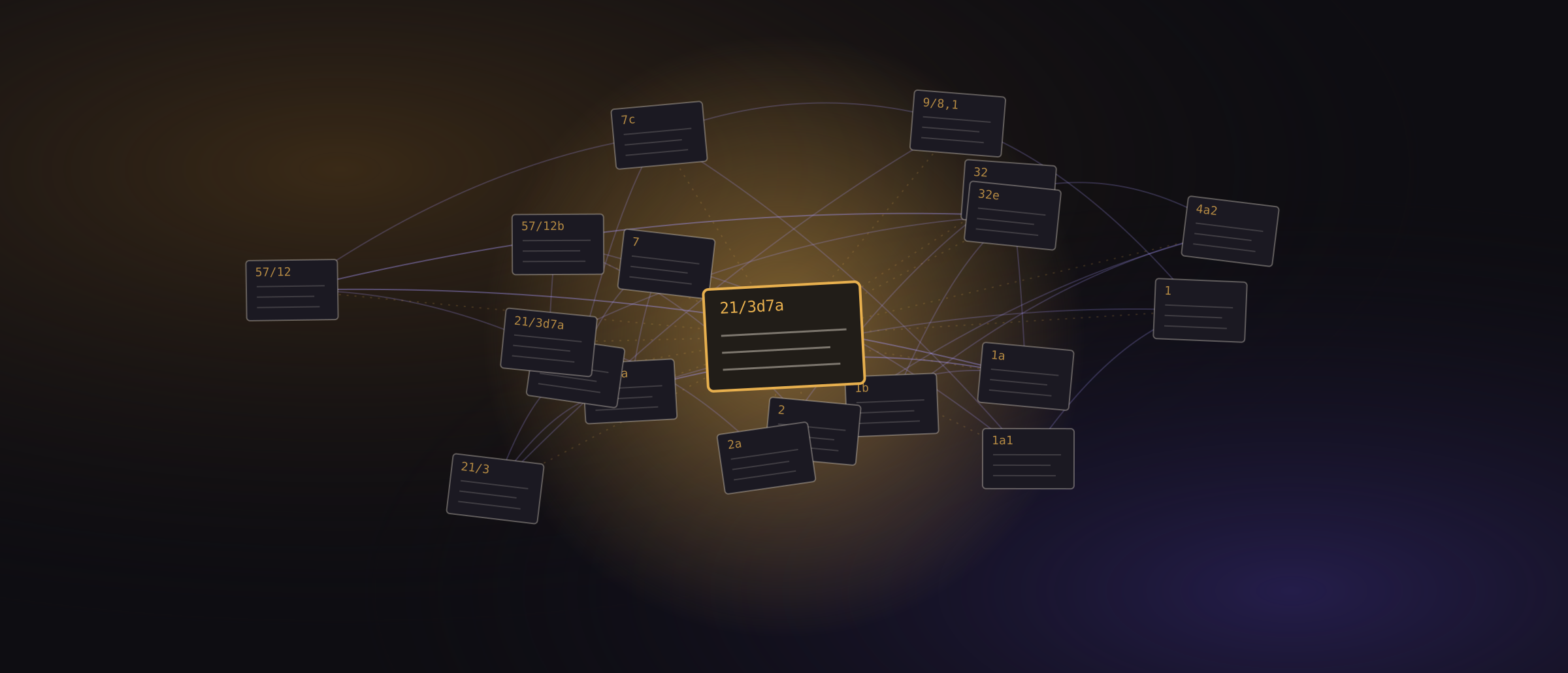
What made the system unusual was not its size but its structure. Luhmann did not file notes under fixed headings. Each slip had a number, and a new note was placed next to the note it continued, branching with numbers and letters (a note numbered 21/3d7 could be followed by 21/3d7a). Notes referred to other notes by number, anywhere in the box. Over time the box became a dense network of cross-references, with clusters of thought that no index had planned.
In 1981 Luhmann wrote an essay about it, “Communicating with Slip Boxes,” and the essay’s central claim is striking. He described the box as a partner in communication. “It is impossible to think without writing,” he wrote, “at least it is impossible in any sophisticated or networked fashion.” And since one has to write anyway, “it is useful to take advantage of this activity in order to create in the system of notes a competent partner o[f] communication.” What makes a partner useful is the capacity to surprise: “One of the most basic presuppositions of communication is that the partners can mutually surprise each other.”3
This is a different theory of the note from the commonplace book’s. The note is not a container for a finished thought. It is a move in an ongoing conversation, and the value of the collection comes from the unexpected connections it returns when you consult it. The intellectual work happens in the writing of the note, which forces a vague idea into a precise sentence in one’s own words, and in the linking, which places it among other ideas.
The memex: notes as associative trails
At almost the same moment that Luhmann began his box, an American engineer imagined a machine built on similar principles. In July 1945 Vannevar Bush, who had directed the United States’ wartime scientific research, published “As We May Think” in The Atlantic. His concern was that scientific knowledge was growing faster than anyone could find it. Libraries indexed material alphabetically or by subject, so that an item could be in only one place, and finding it required following rules. “The human mind does not work that way,” Bush wrote. “It operates by association. With one item in its grasp, it snaps instantly to the next that is suggested by the association of thoughts, in accordance with some intricate web of trails carried by the cells of the brain.”4
His proposed machine, the memex, was a desk holding a person’s books, records and notes on microfilm. Its essential feature was what he called associative indexing, “a provision whereby any item may be caused at will to select immediately and automatically another.” A user could join two items with a keystroke and build named trails through their material. “The process of tying two items together,” Bush wrote, “is the important thing.”4
Bush’s memex was never built, but its central idea, that personal knowledge should be organised by connection rather than by category, became one of the founding ideas of personal computing. It is, in technological form, the same principle as Luhmann’s slip box.
Engelbart: augmenting the intellect
Douglas Engelbart read Bush’s essay as a young radar technician and spent his career trying to build something like it. In a 1962 report for the US Air Force, “Augmenting Human Intellect: A Conceptual Framework,” he defined his goal with care. By augmenting human intellect, he wrote, “we mean increasing the capability of a man to approach a complex problem situation, to gain comprehension to suit his particular needs, and to derive solutions to problems.”5
The emphasis is on comprehension and problem solving, not on storage. Engelbart’s team at the Stanford Research Institute built the oN-Line System, which in a famous 1968 demonstration in San Francisco showed hierarchical outlines, linked documents, a mouse, and two people editing the same text from different places. Engelbart thought of tools and their users as a co-evolving system; a person’s capability depended on the tools, methods and training available to them, and improving any of these could improve the whole.
Engelbart’s vision was a workstation for a highly trained professional. What reached ordinary people decades later was narrower but still influential. Apple’s HyperCard, released in 1987, let Macintosh users build stacks of linked cards without programming, and many people used it as a personal database or notebook. Outliners and personal information managers followed. Wikis, which began with Ward Cunningham’s WikiWikiWeb in 1995, made it easy to create a page simply by linking to it, and some people kept personal wikis as their own memex.
The capture era: remember everything
Around 2008 several conditions arrived at once. Cloud storage became cheap and reliable. Smartphones with cameras put a capture device in every pocket. Search technology could read text even inside photographs. The result was a new generation of note-taking tools built around a single promise.
Evernote, which launched publicly in 2008, stated that promise on its own home page. In 2010 the page read: “Remember Everything. Capture anything. Save your ideas, things you like, things you hear, and things you see. Access anywhere. Evernote works with nearly every computer, phone and mobile device out there. Find things fast. Search by title, tag or even printed and handwritten text inside images.”6
Read carefully, those three verbs, capture, access, find, define the problem of notes entirely as storage and retrieval. The user’s difficulty was assumed to be forgetting: losing the receipt, the article, the idea that came in the shower. The tool’s job was to make capture effortless and retrieval certain. This was the commonplace book’s theory, scaled up by the cloud, with search replacing Locke’s index. Microsoft’s OneNote, introduced in 2003, had made similar promises inside a digital notebook, and both tools found large audiences, because the problem they addressed was real.
The capture era revealed a side effect that Thamus would have recognised. When saving costs nothing, people save far more than they ever revisit. In 2014 Christian Tietze, writing about the slip-box method, gave the problem a name, “the Collector’s Fallacy”: “There’s a tendency in all of us to gather useful stuff and feel good about it. To collect is a reward in itself.” The fallacy, he explained, is that “‘to know about something’ isn’t the same as ‘knowing something’.”7 An archive of thousands of saved articles produces a pleasant sense of being informed. Whether it produces understanding depends on what happens after the save button.
Evernote’s later history is a reminder that tools also have life spans. After years as one of the best-known productivity apps, it was acquired by the Italian software company Bending Spoons, in a deal announced in November 2022 and completed in early 2023.8 Its users’ archives moved with it. That question, of what happens to a lifetime of notes when the company behind the app changes, would become central in the next decade.
The workspace era: notes as building material
Notion represents a different response, and its founders have been open about how difficult the path was. Ivan Zhao, its chief executive, wrote in 2024 that the company “started in 2013, but it wasn’t until 2018 with the Notion 2.0 Product Hunt launch that we saw signs of traction.” In the early years, he wrote, “we were rather lost,” and the team “rebuilt Notion four times in those ‘lost years,’” at one point moving to Japan to rewrite the product on a new technical foundation.9
What emerged was a tool built from blocks. Every paragraph, heading, list, image or embedded table is a block that can be moved, transformed or nested. Pages contain pages. Most importantly, any collection of pages can become a database, with properties, filters and different views of the same records: a table, a board, a calendar. A note about a book can also be a row in a reading list. A meeting note can be linked to a project, which is a row in another database.
Zhao has cited Douglas Engelbart and Alan Kay among his influences, and the connection is visible in the design: the user is treated as a builder of their own tools rather than only a consumer of a fixed application.10 The theory of the note here is neither storage nor conversation but material. Notes become the raw stuff from which people assemble systems for running their lives and their work. In September 2024 Notion reported passing 100 million users.9
This approach dissolved the boundary between notes and operations. A note in Notion is often not a reflection on what one has read; it is a project plan, a task list, a team wiki. That breadth explains the tool’s reach. It also means that the question Luhmann asked, whether the system helps one think, becomes one use among many.
The networked era: links come back
At almost the same time, a small set of tools revived the slip box directly. Roam Research, launched widely in 2020 under the banner of “networked thought,” made bidirectional linking central: when one note links to another, the second note automatically shows the reference back, and individual blocks of text can be referenced and embedded elsewhere.11 Obsidian, released on 30 March 2020 by Shida Li and Erica Xu, who had previously built the outliner Dynalist, offered linked notes too, but stored as plain Markdown files in a folder on the user’s own computer.12
These tools arrived alongside a wave of writing about method. Sönke Ahrens’s 2017 book How to Take Smart Notes introduced Luhmann’s method to a wide English-speaking audience. Tiago Forte’s 2022 book Building a Second Brain popularised a system for capturing and organising information for creative projects. The researcher Andy Matuschak published his own working notes online, organised around what he called “evergreen notes,” written “to evolve, contribute, and accumulate over time, across projects.” His explanation of why such practices matter puts the slip-box theory in one sentence: these practices “aren’t about writing notes; they’re about effectively developing insight: ‘Better note-taking’ misses the point; what matters is ‘better thinking’.”13
The networked tools did something the capture era had not. They treated the link as the unit of value rather than the stored item. A backlink is Bush’s associative trail made automatic: every connection you draw is visible from both ends. And the emphasis on writing in one’s own words, on atomic notes that each hold one idea, restored the step the capture tools had removed: the transformation of something read into something understood.
The same tools also invited their own version of the collector’s fallacy. A graph of thousands of linked notes can be as much a display of activity as a record of thought. The methods themselves warn about this; it is a recurring theme in discussions of note-taking that tending the system can become a substitute for the work it was meant to support. The tool cannot decide which side of that line its user is on.
Who owns a lifetime of notes?
Obsidian’s choice to store notes as ordinary files was a deliberate philosophical position, and its chief executive, Steph Ango, stated it in a short 2023 essay called “File over app.” “If you want to create digital artifacts that last,” he wrote, “they must be files you can control, in formats that are easy to retrieve and read.” He asked tool makers to “accept that all software is ephemeral, and give people ownership over their data.” And he drew the comparison to ancient records: “In the fullness of time, the files you create are more important than the tools you use to create them. Apps are ephemeral, but your files have a chance to last.”14
A related argument had been made in 2019 by researchers at the lab Ink & Switch, in an essay on “local-first software.” Cloud apps make collaboration and access easy, they wrote, “however, by centralizing data storage on servers, cloud apps also take away ownership and agency from users. If a service shuts down, the software stops functioning, and data created with that software is lost.” They proposed principles for software that would keep the primary copy of data on the user’s own devices while still allowing collaboration.15
This concern runs parallel to the storage-versus-thinking debate rather than inside it. A cloud tool can support deep thinking, and a file-based tool can be used merely to hoard. But for a tool meant to hold a lifetime of thought, the question of duration becomes philosophical. Luhmann’s paper slips survived him and now sit in a university archive, digitised for anyone to read. Whether a digital note will be readable in fifty years depends on decisions about formats and ownership made by people who are not its author. The same principle appears in the history of databases, where data routinely outlives the programs that wrote it; the essay on databases on this site follows that thread at length.
The machine reads your notes
The newest chapter changes the problem again. Large language models can read a collection of notes, summarise it, answer questions about it and draft new text from it. Notion added AI features in 2023. Google’s NotebookLM, which began as a Google Labs project shown at Google I/O in 2023 under the name Project Tailwind, was designed so that its answers are grounded in the documents a user provides, with citations back to those sources.16
For the storage theory of notes, this is close to a completion. If the difficulty was finding what you saved, a model that can read everything you saved and answer questions in plain language removes most of it. Retrieval, which Locke solved with letters and vowels and Evernote solved with search, becomes conversation.
For the thinking theory, it raises Thamus’s question with new force. A tool that summarises a document for you saves the reading. A tool that drafts a note from a source saves the writing. Luhmann’s claim was that writing is the thinking: “it is impossible to think without writing.” If that is right, then a system that removes the writing may also remove what the writing was for. The appearance of a well-organised second brain would remain, the semblance of truth in Thamus’s phrase, without the understanding that once came from building it.
That conclusion is not inevitable, and it would be unfair to the tools to assume it. Luhmann valued his box because it could surprise him, and a model that reads one’s own notes and points out connections one had forgotten is, in principle, a more capable conversation partner than any drawer of paper slips. Whether these tools end up as better partners or as better collectors will depend on how they are used, and on whether their designers treat the user’s own writing as the core of the system or as an input to be summarised away.
Understanding the philosophy
Note-taking tools seem like small, practical things. Yet every one of them answers a set of questions philosophers have debated since Plato: what memory is, what it means to know something rather than merely to have it stored, whether a notebook can be part of a mind, where new ideas come from, how knowledge should be organised, what deserves to be kept, and whether a written text can ever answer back. This section takes these questions one by one. Each is explained in plain terms, connected to the philosophical tradition that has thought hardest about it, traced in the history of the tools, tested against its strongest objection, and applied to how people take notes today. The links to named philosophers are interpretations offered to make the ideas clearer; the tool makers mostly did not cite them.
1. The remedy that is also a poison
The idea in plain terms
Every note helps you and harms you at the same time. It helps because you do not have to remember. It harms because you do not have to remember. A saved article spares your memory and also excuses it.
The tradition
In the Phaedrus, Theuth calls writing a pharmakon for memory, and Thamus replies that it is a pharmakon only for reminding. The Greek word pharmakon means both remedy and poison, and in 1968 the philosopher Jacques Derrida made that double meaning the centre of a famous essay, “Plato’s Pharmacy.” Derrida’s point was that Plato’s text cannot settle whether writing cures or harms, because the same property does both: an external record supplements memory by standing in for it, and what stands in for something can also replace it.17
Where it shows up
The capture era of note-taking is the pharmakon at industrial scale. Evernote’s promise to “Remember Everything” was a remedy for forgetting, and the result, archives that are saved but never revisited, is the poison Thamus predicted. The collector’s fallacy is the same observation in modern form: the act of saving produces a feeling of knowing that substitutes for knowing.
The strongest objection
Plato’s worry was, in one sense, refuted by history. Literacy did not make people stupider; it made possible philosophy, science and law on a scale oral cultures could not sustain. Walter Ong argued in Orality and Literacy (1982) that writing “restructures consciousness,” enabling kinds of analysis that memory alone cannot. On this view the cure far outweighs the poison.
What it means today
The useful lesson is not to choose between writing and memory, but to notice which one a particular habit serves. A note that you will reread and transform is a remedy. A note saved so that you can stop thinking about something is, quietly, a poison. Most people’s archives contain far more of the second kind than the first.
2. Having information is not understanding it
The idea in plain terms
You can store an explanation of how a vaccine works without being able to explain it. Owning the text is not the same as owning the understanding, and it is surprisingly easy to confuse the two.
The tradition
Gilbert Ryle distinguished knowing that, the possession of facts, from knowing how, the ability to do something with them. A more recent and very concrete result comes from psychology. In 2002 Leonid Rozenblit and Frank Keil described the illusion of explanatory depth: people who rated how well they understood everyday devices such as zips and flush toilets lowered their ratings sharply after being asked to write out a step-by-step explanation.18 The act of trying to explain revealed how little they understood.
Where it shows up
This is precisely why the slip-box tradition insists on writing notes in your own words. Luhmann’s method, Matuschak’s evergreen notes and Ahrens’s How to Take Smart Notes all require transforming what is read into a new formulation. That transformation is a small explanation test, and it exposes the illusion before it settles in. Highlighting and clipping, by contrast, skip the test.
The strongest objection
Not every note needs to be understood. A phone number, a recipe or a reference is useful precisely because it can be retrieved without being learned. The capture tools are right that much of life consists of things one needs only to find again.
What it means today
It helps to keep two kinds of notes deliberately separate: reference material, which can simply be stored, and ideas, which should be rewritten until you could explain them to someone else. Confusing the first for the second is how archives grow while understanding does not.
3. Can a notebook be part of your mind?
The idea in plain terms
If you rely on your phone to remember every appointment, is the phone’s calendar part of your memory? Many people would say no: memory is in the head. But in practice, the calendar plays the role memory used to play.
The tradition
In 1998 Andy Clark and David Chalmers argued in “The Extended Mind” that cognition can extend beyond the skull. Their example was Otto, a man with memory loss who carries a notebook everywhere. When Otto wants to go to a museum, he looks up its address in the notebook, just as his friend Inga recalls it from memory. If the notebook plays the same role as Inga’s memory, they argued, it should count as part of Otto’s mind. This is their parity principle. They added conditions: the resource must be reliably available, its contents trusted more or less automatically, and easy to consult.19
Where it shows up
Every note-taking tool can be read as an attempt to meet those conditions. Cloud sync makes notes reliably available on every device. Fast search makes them easy to consult. Bush’s memex and Engelbart’s augmentation were explicitly about extending the intellect. Luhmann, writing well before Clark and Chalmers, described his slip box as a “second memory” and a partner.
The strongest objection
The philosophers Fred Adams and Ken Aizawa argued that Clark and Chalmers commit what they called a coupling-constitution fallacy: the fact that something is closely coupled to a cognitive process does not make it part of that process. A pencil used for arithmetic is coupled to thinking without being thought. On their view, the notebook is a tool the mind uses, not part of the mind.
What it means today
Whichever side one takes, the extended-mind debate highlights what matters in a tool: availability, trust and ease. AI note tools raise the stakes, because a system that summarises or answers questions from your notes may not be reliable enough to be trusted “more or less automatically.” A notebook that occasionally rewrites what you said is a strange part of a mind.
4. Where new ideas come from: surprise as information
The idea in plain terms
A note that tells you something you already believe teaches you nothing. A note that connects two ideas you never thought to connect can change your thinking. The value of a collection lies less in what it contains than in the unexpected encounters it makes possible.
The tradition
Luhmann built his slip box on his own theory of communication, in which information is not a thing that is transmitted but an event that happens when a message is compared with other possibilities and turns out to be unexpected. That is why he insisted that partners in communication must be able to “mutually surprise each other.”3 The anthropologist Gregory Bateson defined information in 1972 as “a difference which makes a difference,” and Claude Shannon’s mathematical theory of communication measures information by how improbable, and therefore surprising, a message is. Across these very different traditions, the same idea recurs: information is surprise.
Where it shows up
Luhmann placed new notes next to related ones and linked them to distant numbers, so that consulting one note would lead to others he had forgotten. Bush’s associative trails, backlinks in Roam and Obsidian, and the graph views of linked-note tools all try to engineer the same encounters. The tools work, when they work, by putting your past thoughts in unexpected contact with each other.
The strongest objection
Surprise is not the same as insight. A random pairing of notes is surprising and almost always useless. Luhmann’s box surprised him productively because it was organised by a single mind over decades, so its connections reflected real lines of thought. Mechanical linking, or an AI suggesting “related” notes by word similarity, may produce noise rather than discovery.
What it means today
The question to ask of a note system is not how much it holds, but how often it shows you something you did not expect and could not have found by searching for what you already had in mind.
5. Trees and networks
The idea in plain terms
You can organise notes into folders inside folders, each note in one place. Or you can connect notes to each other freely, so that any note can lead anywhere. These are two different pictures of how knowledge is shaped.
The tradition
Bush’s 1945 complaint was that indexing systems file each item in only one place, while “the human mind does not work that way. It operates by association.”4 In 1965 the architect Christopher Alexander made a parallel argument about urban design in an essay titled “A City Is Not a Tree”: planned cities organised as strict hierarchies feel lifeless because real social life overlaps in many directions, a structure mathematicians call a semilattice. In 1980 the philosophers Gilles Deleuze and Félix Guattari contrasted the tree, with its single root and branching hierarchy, with the rhizome, a root system in which any point can connect to any other.
Where it shows up
Evernote’s notebooks and most file systems are trees. Tags allow one note to sit in several places at once. Wiki links, backlinks and Luhmann’s numbered cross-references produce networks. Notion combines both: pages nest in a hierarchy, but databases and links cut across it.
The strongest objection
Pure networks become tangles. Without some hierarchy, a large collection is hard to navigate and impossible to survey. Even Luhmann kept a register of keywords as an entry point into his box. Trees offer orientation; networks offer discovery. The most usable systems combine them.
What it means today
It is worth deciding consciously which parts of a collection need a stable structure, projects, references, areas of responsibility, and which should be allowed to grow by connection, ideas, questions, observations.
6. What deserves to last, and what deserves to be forgotten
The idea in plain terms
A lifetime of notes could outlast the company that stores them, or vanish with it. Some notes are worth preserving for decades; others are better forgotten.
The tradition
Steph Ango’s “file over app” argues that “the files you create are more important than the tools you use to create them,” and the Ink & Switch researchers argued that cloud software can “take away ownership and agency from users.”14 Internet pioneer Vint Cerf has warned of a possible “digital dark age” in which records become unreadable as software and formats disappear. On the other side stands Friedrich Nietzsche’s 1874 essay “On the Uses and Disadvantages of History for Life,” which argued that a capacity to forget is necessary for action: a person who could forget nothing would be paralysed by the weight of the past.
Where it shows up
Obsidian’s plain files, local-first software and export features embody the preservation side. The capture era’s endless archives illustrate Nietzsche’s worry: a collection so complete that it is never used, because nothing in it was ever chosen.
The strongest objection
Preservation and forgetting are not opposites to be balanced once; they are judgements to be made note by note. The real failure is not keeping too much or too little, but keeping without deciding.
What it means today
Durable formats protect what matters. Periodic pruning protects attention. A note system serves its owner best when it is easy both to keep things for a lifetime and to let things go.
7. Notes that answer back
The idea in plain terms
A written note has always been silent. You can read it, but you cannot ask it what it meant or how it relates to something else. AI tools that read your notes and answer questions about them change that for the first time.
The tradition
Thamus’s first objection to writing was about memory. Socrates adds a second objection a few lines later in the Phaedrus, and it is the one most relevant now: writing, he says, is like painting, “for the creations of the painter have the attitude of life, and yet if you ask them a question they preserve a solemn silence.” A written speech, if questioned, “always gives one unvarying answer.”20 For Socrates, real understanding came from dialogue, from questions and answers, which writing could not provide.
Where it shows up
Luhmann tried to overcome this silence by structure: his slip box could “answer” by leading him to related notes. Linked-note tools extend the same idea. AI tools such as NotebookLM go much further, answering questions in natural language, grounded in the user’s own sources. In a literal sense, they remove Socrates’ objection: the notes can now be questioned and will reply.
The strongest objection
An answer is not the same as a dialogue with a mind. The AI’s replies are generated by a system that may misrepresent the notes, and its fluency can disguise errors. More subtly, Socrates valued dialogue because it forced the questioner to think. A system that answers too readily may do the opposite, giving the user the conclusion without the thinking that would have produced it.
What it means today
The new tools fulfil one of the oldest wishes about writing and revive the oldest fear about it in the same moment. Used as a partner that points back to one’s own words and asks better questions, an AI can be the interlocutor Socrates found missing in books. Used as an oracle that answers instead of the user, it becomes the most efficient pharmakon yet: a remedy for not knowing that removes the need to know.
Bringing the threads together
The history of note-taking tools turns out to be a long conversation with Plato. Writing is both remedy and poison, and every tool chooses which side to strengthen. Storing is not understanding, and the tools that demand rewriting in one’s own words are the ones that close the gap. A notebook can function as part of a mind when it is available, trusted and easy to use, conditions AI makes both easier and harder to meet. New ideas come from surprise, which structure can cultivate and randomness cannot. Knowledge needs both trees and networks. Durability and forgetting both have value. And with AI, notes have at last begun to answer back, which turns Socrates’ old objection into a design question: whether those answers will make us think, or let us stop.
Why the second brain is a writing problem
Return to the question at the top: is a note a place to store what we know, or a way of finding out what we think? The tools have answered it differently in different decades, and the reasons have been mostly practical. When storage was scarce, notes had to be selective. When storage became free, tools encouraged people to keep everything. When keeping everything produced archives nobody read, tools turned to links. When links became hard to maintain, machines offered to read the archive for us.
What runs through the whole history is a single, durable observation, stated most clearly by the person who built the most famous note system of the twentieth century. Luhmann’s box could surprise him because every card in it had been written by him, in his own words, in response to something he had read or thought. The surprise came from his past self, preserved precisely enough to argue with. The box was not a second brain that thought instead of him. It was a record of his thinking, organised so that it could keep thinking with him.
That suggests a quiet conclusion for anyone choosing a tool, and for anyone building one. Thamus was right that writing can produce “the show of wisdom without the reality.” He was wrong that it must. The difference has always been in the transformation that happens when a person puts an idea into their own words and decides where it belongs. A tool that preserves that transformation can be a genuine partner in thought, whatever it is built from. A tool that removes it, however well it remembers, will mostly help us remember what we never understood.
Selected bibliography
- Plato. Phaedrus. Translated by Benjamin Jowett. Project Gutenberg. gutenberg.org/ebooks/1636
- Locke, John. A New Method of Making Common-Place-Books. London, 1706 (first published in French, 1686).
- Bush, Vannevar. “As We May Think.” The Atlantic Monthly, July 1945. W3C transcription
- Engelbart, Douglas C. Augmenting Human Intellect: A Conceptual Framework. SRI Summary Report AFOSR-3223, October 1962. dougengelbart.org
- Luhmann, Niklas. “Kommunikation mit Zettelkästen” (1981). English translation by Manfred Kuehn, “Communicating with Slip Boxes.” luhmann.surge.sh
- Universität Bielefeld. Niklas Luhmann-Archiv. uni-bielefeld.de
- Clark, Andy, and David Chalmers. “The Extended Mind.” Analysis 58, no. 1 (1998): 7–19.
- Kleppmann, Martin, Adam Wiggins, Peter van Hardenberg, and Mark McGranaghan. “Local-First Software: You Own Your Data, in Spite of the Cloud.” Onward! 2019: 154–178. inkandswitch.com
- Ahrens, Sönke. How to Take Smart Notes. 2017.
- Forte, Tiago. Building a Second Brain. Atria, 2022.
- Tietze, Christian. “The Collector’s Fallacy.” Zettelkasten.de, 20 January 2014. zettelkasten.de
- Matuschak, Andy. “Evergreen notes.” notes.andymatuschak.org
- Ango, Steph. “File over app.” 1 July 2023. stephango.com
- Zhao, Ivan. “100 million of you.” Notion blog, 2024. notion.com
- Derrida, Jacques. “Plato’s Pharmacy.” 1968; in Dissemination, trans. Barbara Johnson, University of Chicago Press, 1981.
- Ong, Walter J. Orality and Literacy: The Technologizing of the Word. Methuen, 1982.
- Rozenblit, Leonid, and Frank Keil. “The Misunderstood Limits of Folk Science: An Illusion of Explanatory Depth.” Cognitive Science 26, no. 5 (2002).
- Adams, Fred, and Ken Aizawa. The Bounds of Cognition. Blackwell, 2008.
- Bateson, Gregory. Steps to an Ecology of Mind. 1972.
- Shannon, Claude E. “A Mathematical Theory of Communication.” Bell System Technical Journal 27 (1948).
- Alexander, Christopher. “A City Is Not a Tree.” Architectural Forum 122 (1965).
- Deleuze, Gilles, and Félix Guattari. A Thousand Plateaus. 1980; trans. Brian Massumi, 1987.
- Nietzsche, Friedrich. “On the Uses and Disadvantages of History for Life.” 1874.
Research limitations
The Phaedrus passage is quoted in Jowett’s nineteenth-century translation; modern translations differ in wording. Luhmann’s essay is quoted from Manfred Kuehn’s English translation rather than the German original. The 90,000 figure for the slip box is the Bielefeld archive’s approximation. Founding and launch dates for Evernote and Roam differ across sources, so the essay uses public launch dates. Statements about Ivan Zhao’s influences come from interviews and secondary profiles rather than a single primary statement, and are presented accordingly. The essay does not attempt to measure whether any method of note-taking improves learning; claims about the value of writing in one’s own words are presented as the stated views of practitioners such as Luhmann and Matuschak and as the author’s interpretation, not as experimental findings. The philosophical section relates note-taking to Plato, Derrida, Ong, Ryle, Clark and Chalmers, Luhmann, Bateson, Shannon, Alexander, Deleuze and Guattari and Nietzsche; except for Luhmann’s own theory and Clark and Chalmers’ explicit notebook example, these connections are the author’s interpretation, offered to make the ideas understandable.
Footnotes
-
Plato, Phaedrus 274e–275b, trans. Benjamin Jowett (Project Gutenberg edition). ↩
-
Universität Bielefeld, Faculty of Sociology, “Niklas Luhmann-Archiv,” uni-bielefeld.de. ↩
-
Niklas Luhmann, “Communicating with Slip Boxes,” trans. Manfred Kuehn, from “Kommunikation mit Zettelkästen: Ein Erfahrungsbericht” (1981), luhmann.surge.sh. ↩ ↩2
-
Vannevar Bush, “As We May Think,” The Atlantic Monthly, July 1945, sections 6–7; text from the W3C’s historical transcription. ↩ ↩2 ↩3
-
Douglas C. Engelbart, Augmenting Human Intellect: A Conceptual Framework (Stanford Research Institute, October 1962), §I.A, paragraph 1a. ↩
-
Evernote home page, archived 2010 by the Internet Archive, web.archive.org/web/2010/http://www.evernote.com/. ↩
-
Christian Tietze, “The Collector’s Fallacy,” Zettelkasten.de, 20 January 2014. ↩
-
Coverage of the Bending Spoons acquisition, announced November 2022 and completed early 2023; see, for example, Wikipedia: Evernote Corporation and reporting cited there. ↩
-
Ivan Zhao, “100 million of you,” Notion blog (2024), notion.com/blog/100-million-of-you; the September 2024 date is reported by, among others, Siècle Digital, 9 September 2024. ↩ ↩2
-
Notion, “How to build tools that shape civilizations: Alan Kay and Ivan Zhao” (webinar description), notion.com; Zhao’s remarks on Engelbart are reported in interviews and secondary profiles. ↩
-
Roam Research describes itself as “a note-taking tool for networked thought”; for its founder and launch, see the 20VC interview with Conor White-Sullivan, thetwentyminutevc.com. ↩
-
Wikipedia: Obsidian (software), release date 30 March 2020; and Ness Labs, interview with Obsidian’s co-founder, nesslabs.com. ↩
-
Andy Matuschak, “Evergreen notes,” notes.andymatuschak.org/Evergreen_notes. ↩
-
Steph Ango, “File over app,” 1 July 2023, stephango.com/file-over-app. ↩ ↩2
-
Martin Kleppmann et al., “Local-first software: You own your data, in spite of the cloud,” Ink & Switch, April 2019; Onward! 2019, pp. 154–178, doi:10.1145/3359591.3359737. ↩
-
Google, “The inside story of building NotebookLM,” blog.google. ↩
-
Jacques Derrida, “Plato’s Pharmacy” (1968), in Dissemination, trans. Barbara Johnson (University of Chicago Press, 1981). ↩
-
Leonid Rozenblit and Frank Keil, “The Misunderstood Limits of Folk Science: An Illusion of Explanatory Depth,” Cognitive Science 26, no. 5 (2002): 521–562. ↩
-
Andy Clark and David Chalmers, “The Extended Mind,” Analysis 58, no. 1 (1998): 7–19. ↩
-
Plato, Phaedrus 275d–e, trans. Benjamin Jowett (Project Gutenberg edition). ↩
How it evolved
The arc
- c. 370 BC
In Plato’s Phaedrus, the Egyptian king Thamus warns that writing will give people “the show of wisdom without the reality.”
- 1706
John Locke’s method for indexing a commonplace book is published in English, two decades after its French debut.
- 1945
Vannevar Bush’s “As We May Think” imagines the memex, a desk that would link records by association rather than by index.
- 1951
Niklas Luhmann begins the slip box that will grow to about 90,000 notes by 1996.
- 1962
Douglas Engelbart defines “augmenting human intellect.” His 1968 demonstration shows linked, shared, on-screen text.
- 1981
Luhmann publishes “Communicating with Slip Boxes,” describing his notes as a partner able to surprise him.
- 1987
HyperCard brings linked cards to ordinary Macintosh users.
- 2008
Evernote launches publicly with a promise to “Remember Everything,” from any device.
- 2018
Notion 2.0, built from blocks and databases, finds traction after five years and several rebuilds.
- 2020
Roam Research popularises bidirectional links; Obsidian launches on local Markdown files.
- 2023
AI arrives inside note tools. Google’s source-grounded NotebookLM begins testing, and Obsidian’s CEO argues for “file over app.”
- 2024
Notion passes 100 million users. The note-taking tool has become a workspace, a database and an AI assistant at once.
Left open
Questions to sit with
- If a machine can summarise everything you have saved, what is left that only writing it yourself could give you?
- Which of your notes have ever surprised you, and what was different about how you wrote them?
- Should the tools we think with be built to last longer than we do, or only as long as we need them?
Follow the thread
Where this essay connects
Shrikant Kumar. “Notes That Talk Back: The Long Search for a Second Brain.” Essay on Note-Taking Apps, Telos, published 10 April 2022, updated 19 October 2026. https://shrikantk.com/blog/notes-that-talk-back/